Online now
Online now

Madam's Manor

Welcome to Madam's Manor, a space dedicated to the authentic exploration of the Dominance and submission (D/s) lifestyle. Authored by Madam and Her servant, this blog is an open chronicle of our personal journey, the everyday realities of our dynamic, and the lessons we continue to learn together.

We created Madam's Manor not just to share our story, but to serve as a guiding light for others. Whether you are simply curious, taking your very first steps into the lifestyle, or looking for ways to strengthen an existing dynamic, you will find a welcoming community here. Through education, practical advice, and dedicated mentorship, we are here to help you navigate the beautiful complexities of power exchange with safety, clear communication, and profound connection. Step inside, and let's grow together.
1 week ago. Sunday, July 12, 2026 at 5:10 PM

Madam's Manor: Different types of Dominants and submissives

The lists below are not a one size fits all nor do you have to fall into just one category. You can have bits and piece from different ones or be more than one type.


D-types


  • Master: These Doms demand absolute submission from their slaves. Their goal is to have a high level of control and authority over subs’ life, within and often outside the scene. Masters are leaders so they like to establish rules, daily routine and clear expectations. They may also establish a particular dress code and demand making love in certain positions.
    • Masters require from the subs a clear understanding of their demands and consequences for disobedience. To make subs more relevant to their own expectations, Masters can incorporate training, including fulfillment of chores and tasks. When the sub meets the Master's expectation, they reward them. When they fail, they punish them.
    • Masters have power, but they also bear great responsibility, both during the activities and afterwards. Masters prioritize subs’ health, safety, and well-being. They devote time to aftercare, providing support and comfort after the scene is over.
  • Caring Dom: This one relies on establishing emotional bonds, building trust and encouraging subs to grow and become better. Caring Doms combine controlling aspects with empathy and responsibility. Their main goal is to care about the sub, so they take time to understand their needs, desires and emotions in order to provide the best emotional experience.
    • Caring Doms make a great focus on aftercare after the BDSM scene. They also regularly check in on whether their sub feels well and protected. To encourage the sub to improve their behavior, they sincerely praise them.  They do their best to improve the sub’s self-esteem and make them confident in achieving their goals. Regarding pleasure, these Doms try to make the dynamic satisfying and fulfilling for both.
    • Caregivers (Daddy, Mommy) are of the remarkable examples of caring Doms, who take on parental and nurturing roles and create a safe environment for their subs (little boys or girls). Mommy/Daddy dynamic may include age regression when the subs behave like they are much younger than their actual age, while Daddy or Mommy comforts, protects and fulfills little’s needs.
  • Rigger/Rope Top: These Doms are in love with ropes and the process of tying their subs, also known as rope bottom. They are skilled and talented in using various techniques. They know all the secrets of knots, ties and patterns to provide intensive experience for both.
    • Rope tops are aware of the responsibility they take, so they pay a great attention to safety and subs’ well-being. They understand the risks of nerve damage and circulation issues. They know which pressure points are better to avoid and what knots are beneficial.
    • Riggers’ role goes hand in hand with art, so they often involve decorative knots and interesting patterns to provide both a new sensual experience for bottoms and create an aesthetic environment. However, it doesn’t mean that riggers are limited solely to ropes. They can incorporate other BDSM equipment such as leather harness to combine with ropes, spreaders to keep subs’ limbs apart, gags and blindfolds for sensory deprivation and heightened sensations.
  • Financial Dom: These Doms, often called FinDoms, take control over subs’ budget and financial operations. The power exchange is based on money. They enjoy the power that comes with providing and controlling subs’ well-being. They get aroused from the fact that submissives give up their financial resources and depend on them.
    • FinDoms’ sphere of influence may include control over subs’ spending habits, setting up financial goals, demanding gifts and restricting access to money and accounts as a form of punishment. They may also demand purchasing certain items from the wish list.
  • Owner: These Doms treat their subs like their property or their slaves. They control subs daily routine, personal decisions and behavior. At the same time, they take responsibility for sub’s well-being, safety, and development. To make submissive match their own standard, they may incorporate training, obedience to rules and system of rewards and punishments depending on subs’ progress.
    • Regarding daily control, Owners can select certain types of clothes for subs, establish their schedule, form the list of chores and tasks, or even create their diet. Owners select sex positions and keep their eye on subs’ activities.
    • The Owner can engage in Pet play, where they represent the Handler while the sub takes on the role of a kitten, puppy, rabbit or any other pet. Within this dynamic Owner can train, feed, reward, punish their animals and care about them.
  • Primal Dom: These Doms incorporate elements of primal play into their interaction with the sub. They are ruled by instincts, carnal desires and raw emotions. Primal Doms behave like animals: they growl, bite, scratch and howl. Their interaction with the sub may include physical actions like wrestling or using teeth and nails (claws). They may chase or hunt their subs like wild animals do in their natural habitat.
    • These Doms are energetic and intense, so activities with them can be both exhilarating and intimidating for submissive partners. Primal Doms may have their own rituals to emphasize their dominance and possession. They can also have their own method of communication, such as gestures.
  • Sadist: These dominants get aroused and pleased through inflicting pain to their subs. They like to play with pain and pleasure and eagerly incorporate a wide range of BDSM accessories and tools for that purpose. This may start with floggers and leather spanking paddles and gradually move to spreader bars, connectors, cuffs, nipple clamps, straitjacket and hoods.
    • They can use verbal abuse to humiliate their subs and remind them where they belong. Sadists may use name-calling, or tasks that challenge the submissive's sense of dignity. In some cases, they may even involve consensual non-consent, where the subs protest against Sadists’ actions playfully.
    • Sadists like to incorporate bondage and restraints. They may tie their slaves to a bed by using bed restraints or shackle them with chains. Sadists like edge play, including activities with extreme elements such as knives, fire, electricity. Having such wild and extreme interests, sadists seriously approach the physical and emotional safety of their partners. They discuss the boundaries before the play and provide aftercare after games are over. 
  • Pleasure Dom: These Doms’ actions can raise subs to the peak of pleasure. They derive the pleasure from the process of satisfying their subs. They are also associated with orgasm control. Pleasure Doms know all of the sub’s secret spots and buttons to bring them to the edge of pleasure. They know how and where to stimulate to create multiple orgasms.
    • Pleasure Doms have a rich collection of sex toys and equipment to combine their magic hands with them for a better result. They like to explore various forms of impact and sensual play. They like to massage subs’ bodies, paying attention to erogenous zones, and play with feathers, ice, candles, silk, or fur.
    • Pleasure Doms are talented at building tension and anticipation. Apart from giving partners intense emotions, they can also bring them closely to orgasm and then ruin it, or they can torture their subs with many orgasms testing their limits.
    • These Doms can incorporate role-playing such as teacher/student, doctor/patient, and other forms to immerse subs in a fancy world. Pleasure Doms can even worship certain body parts such as feet, toes, breast, ears, and others.
  • Service Top: Their goal is to fulfill the bottom’s desires, kinks and fantasies. They derive pleasure from giving satisfaction to a sub rather than fulfilling their own needs.  Dominance may not be the part of their personalities, however when they take on this role during BDSM scenes they are active and work their best on serving people.
    • Service tops know everything about how to safely and exclusively execute the scene with the main focus on the sub’s preferences. They like role-playing and work on the mutual pleasure during it.  Tops teach the subs to discover their own desires and they are responsive to their changes in needs and dynamic. Regarding activities, service tops like to incorporate canes and spanking paddles for impact play, dress in other characters for role-playing, use wax and ice to create intense sensory experience. They can also incorporate restraints and ropes for bondage.
  • White Knight Dominant: These Doms see themselves as the sub’s protectors and rescuers. They mainly focus on support and guidance during the activities. White knight Doms care for charity and kind actions. Thanks to their values, they are considered altruists. Knights provide reliable support for those with broken hearts and frustration. They like to solve the sub’s problems and guide them towards personal growth. Nights’ priority is the sub’s well-being.
    • They engage in BDSM scenes with the strong emphasis on mutual trust and respect. Knights are caring personalities so they do their best to create a nurturing environment for their princesses, where they can explore their desires in a comfortable and safe way. The power dynamic is based on the white knight’s authority balanced with their responsibility.
  • Leather Doms: These Dominants make a great accent on their male beauty by wearing leather clothes and accessories. Their outfits may include leather jackets, pants, vests and harnesses. These Doms’ roots are connected with the gay leather subculture. They embody values of respect, discipline and honor.
    • Leather Dominants often discover for newcomers the fascinating world of BDSM taking a guiding role. They follow protocols to create a safe, consensual and controlled environment for their subs as well as practice rituals. Leather Doms like to build the sense of brotherhood within the community. 
  • Gentle/Soft Dom: These Doms prioritize a nurturing environment and emotional connection over control and punishments. They do their best to help subs move towards their personal growth and self-love. Gentle Doms are very caring and patient within the BDSM dynamic. Unlike traditional Dominants, they are more focused on sub’s well-being and trust. They are very attentive to details and sub’s desires. They mainly use encouragement and positive reinforcement rather than punishment. They are fast to praise but very slow to punish. They use polite language even when they tell subs what to do.
    • Soft Doms provide a sense of protection and comfort allowing their subs to feel cared for and valued. This doesn’t mean that soft Doms do not care about authority. They do, however they express it through affection and care. Unlike pleasure Doms who focus on bringing pleasant experience for the submissive, soft Doms’ leading role goes hand in hand with erotic tenderness. This dominance is perfect for subs who search for the balance between authority and affection.
  • Dominant Mentor: These Doms are experts in guiding newcomers in the world of BDSM. They are not engaged in power exchange in the same way as in the dominant-submissive relationship. They mainly focus on listening to subs and giving them advice. Mentors teach them how to use fetish equipment and BDSM gear. Sometimes they incorporate particular tasks and practices to help the sub learn faster. They are always patient and helping. Mentors also assist newcomers in finding their own dominant or submissive styles.
    • Mentors can share their own experiences and provide feedback as well as help the subs with resources to develop their skills. Their priority is to create a safe and learning environment, helping subs to discover new things and grow.
  • Cuckold Dom: These Doms derive pleasure from seeing their subs engaged in sexual relationships with other people. The dynamic often includes the elements of voyeurism and humiliation. They like when the subs share their personal experience and secrets. They like to control and orchestrate the sub’s interaction with other people.
    • Cuckold Dominants find pleasure in seeing their subs vulnerable as well as having the overall control over the situation. This power dynamic demands a high level of trust and consent from all the parties involved. Regarding activities, they can incorporate verbal humiliation, keeping the sub in a chastity gear, denying sexual gratification, public display as well as taking photos and videos of the interaction and then sharing them.


S-types


  • Service Sub: These subs specialize in fulfilling chores, tasks and duties in order to please their Dominants partners. This includes activities with a strong accent on their submissive role, for instance, serving like a chair or table, kneeling before their Dominants, dressing their Dominants, refilling drinks, bringing food, doing laundry, cleaning a house or a Dominant's car.
    • Serving may also include sexual service for Dominants and their guests. For service subs, the act of serving works as a sexual gratification. Since serving often includes fetishes, the sub may massage the dominant’s toes, or provide a full-body massage focusing on particular erogenous zones. Service subs like to be lower than their masters in all aspects of their relationships.  
  • Slave: These subs have no other desire except pleasing their Dominants, and they are ready to do anything to fulfill this desire. They follow the rule: if the Dom is happy with me, then I’m happy. Slaves are involved in slave-Master relationships 24/7. Being so dependent on their Doms they always ask permission to do something, even if they want to eat, drink, use a bathroom or masturbate. They are ready to obey any rule and command, as well as surrender control all the time. Slaves are consistently sexually available and ready to please their Master in any position.
    • The Master has absolute control over the slave’s desires and body. The slave acts like their property. The Master can also be a woman, Mistress, as this dynamic isn’t limited to certain gender and sexual orientation. Slaves can not only serve their Dominants all day and night, but also be a part of sexual slavery within a role-play.
    • Regarding accessories and symbols, slaves usually wear a slave collar as a symbol of their Ownership. They can also react to certain names chosen by the owner. Slaves typically engage in a training process where they learn to follow the rules and improve their behavior.  
  • Pet: These subs act similar to pets, taking on roles of kittens, puppies, rabbits, pony boys and girls. For a more immersive atmosphere, pets often wear costumes and specific accessories, including leather harnesses, ears, masks with muzzles, fur and other things.
    • Acting like an animal, these submissives move on four legs and produce animalistic sounds. They can bark, growl, or meow, depending on a chosen role. Their Owners can collar them and attach the leash to walk them or put a self-tightening-collar on them to control and correct their bad behavior.
    • Pets eat and drink from the bowl on the floor and sleep on the doormat if the owner orders them to do it. They react to commands and fulfill them. Pets obey certain actions and sounds such as a riding crop or a strike of a spanking paddle. Pets like to play with the balls and other pet toys. Instead of offering their body for pain and sexual pleasure, pets offer it for entertainment. They communicate not with the help of words, but rather they use body language and verbal cues.
  • Masochist: Masochists are hooked as soon as Doms incorporate painful activities. Depending on their experience, they can enjoy pain of different intensity. Masochists misbehave on purpose to be punished by the Sadist. They get aroused when Dominants spank them, drip hot wax on their skin, use clamps on nipples, or pierce their sensitive areas with needles. They can go extreme and enjoy knife play, rope bondage, fire play and electricity play.
    • Masochists find pleasure in denial, humiliation, and degradation. Unlike other subs, masochists may not have even the slightest desire to submit. They just need pain. Within the Sadist-masochist dynamic, these two may look like that the one has control over the other, the one is a Dominant and the other is a slave.  However, this dynamic may be just a temporary action, and outside the dungeon, and when the game is over, these two may not continue to exchange power that way.
    • Masochists somewhat eroticize pain and activities providing it, including spanking, flogging, bondage, as the way to intensify their sexual responses. They don’t restrict their reactions: they can groan, cry, moan, allowing their body to react to pain.
  • Bedroom Submissive: These subs act like subs only in a bedroom setting, while outside it, they may not be interested in BDSM relationships at all. However, in the bedroom, they are always ready to let their masters take control of them. This type of submission has its time limits, since as the game is over, individuals come back to their normal lifestyle.
    • Bedroom submissives like when their partner ties them with ropes, shackles their wrist and ankles with cuffs, covers their eyes with blindfolds, and uses spreader bars to restrict their limbs’ movement. They like to receive stimulation with dripping wax, ice cubes, pins, clamps. Within the scene, they are ready to fulfil their master’s desires, tasks, and orders. Regarding pleasure, bedroom submissives can provide oral and manual stimulation, vaginal sex, massages, and other services.
  • Finsub (Financial Submissive): The center of a power dynamic within this relationship is money, so these subs give money or provide gifts for their Findoms. The sub within this dynamic can bear various names – money slave, paypig, finsub, cash piggy. In most cases, these relationships are distant, both participants engage in them online, so that Findom and finsub never meet each other in real life. However, in some cases, finsub can accompany their Dominants during shopping, when the Dom spends their money.
    • The sub give the Dom money, buys gifts, provides access to their financial accounts and cards without any expectations of sexual relationships. They give out their money without anything in return, and they like to pay rents, debts, and housing. Many finsubs appreciate matriarchy, so this style matches their vision of women as individuals superior to men.
  • Rope Bunny: These subs like when their Dominants (rope tops or riggers) tie them in various positions. They have enough patience for the rigger to do intricate knots, patterns, and ties. They get aroused when being restricted in movement with ropes and having sexual activities in these positions. They derive pleasure from the physical sensations of vulnerability and the aesthetic aspect of the rope patterns.
    • The rope bunny fully trusts the Rigger, being confident that they respect their limits in return. For them, the art of tying can act as both artistic and erotic activity. Some rope bunnies engage in bondage to create impressive images or performances. They can feel excitement when experiencing rope patterns on their skin as if they were "rope lingerie," as well as when their wrist, ankles, and other body parts are restrained with knots and ties. They also welcome when the bondage is combined with sensory play incorporating accessories such as blindfolds, gags, hoods, etc. 
  • Sex Slave: The service of these subs is focused on sex and delivering all kinds of pleasure to their Masters through intimate activities. They desire orgasms and intense experiences, so they may be very eager for their Master’s caress.  Motivated by sex, these submissives are ready to fulfill any order and task as well as trust their bodies and souls to their Dominants.
    • Sex slaves derive pleasure from being controlled and dominated. They are often involved in activities including elements of bondage with cuffs or ropes, role-playing, humiliation and punishment through spanking or collaring. Sex slaves live with their Dominant partners on a full-time basis and are always available for sex. They may not have any external life outside serving their mate.
  • Romantic Sub: These submissives focus on giving up everything for the sake of romantic feelings, rather than becoming just a slave. They are emotionally invested in submission and in love with an idea of it, caring not so much about how it may end.
    • Unlike other types of submissives who may mainly focus on physical or sexual dynamics, romantic submissives see emotional intimacy, devotion, and love as their key priorities. Their submission is based on romantic feelings and acts of expressing affection and trust. They expect their Dominants to be protective, caring, loving, and supportive. An ideal Dominant for them is the one that takes on a guiding or nurturing role.
  • Submissive Princess: These subs expect deep adoration from their Dominants. In some cases, they desire absolute worship. Only when Dominant partners are ready to show their excitement and affection, and they surrender control to them. This has nothing to do with the absence of respect towards Dominants. Princesses just think highly of themselves and feel like they don’t belong to typical subs who give up so easily.
    • Submissive princesses like to be cared for and caressed. They want to feel that their Dominants are ready to treat them like representatives of a royal family and do anything they want. Their acts of resistance often include whining.
  • Bottom: Bottom submissives like to receive sensation during play. They focus on prior negotiated terms, as they like to receive what they expect. Typically, submissives don't usually declare their wants during the play, however bottom subs do it.
    • Unlike other submissives who typically give up authority and receive various stimulations on the instruction of a Dominant, bottoms don’t give up authority. They like to control how, under what circumstances, with what dynamic, and to what degree they receive stimulation. Bottoms are typically involved in activities such as bondage, spanking, sensation play, and assuming specific roles that reflect their submissive nature. Bottoms may not be subs outside specific interactions.
  • Age Player: These subs take on the role of a character who is younger than their actual age. In other words, these are adults, who like to act like children. They may select a baby or a teenager’s role and get really deep in the head of their character. To emphasize their role visually, they may dress according to the chosen character, wearing mittens, booties, doll dresses, or diapers. They expect care and nurturing acts from their Dominants. Ideally, their Dominants should be caregivers who take all the responsibility for their well-being, discipline, diet, and routine. Age players are often involved in activities like playing with toys, cuddling with their “parents”, drawing, and singing songs.
    • Among age players, you can also meet the “littles”. These adults in baby roles seek more care from their Dominants who fulfill a parental role. Little subs usually act as if they are immature and expect a dom to guide them in this complicated life.  Unlike age players, these subs may incorporate a very sexy vibe into their role.
  • DD Bottom: The key aspect within this dynamic is domestic discipline (DD) and keeping everything in order at home. DD bottoms expect from their partner a strong disciplinary role. They are ready to be punished if they misbehave, break a rule or don’t cope with chores. The Dominant's partner, often referred to as the Head of Household (HoH), creates a specific structure and expects the sub to follow and respect it. If the DD bottom fails (e.g. forgets to pay bills or buy some products), Dominants may incorporate disciplinary measures such as verbal admonishments or physical punishments. DD bottom dynamic is what real couples frequently practice.
  • Brat Submissive: These subs are cheeky, disobedient, and naughty. They like to play, tease and are not against some punishment. They derive pleasure from playing cat and mouse, driving their brat tamers, and doing everything to challenge the Dominant’s authority. Their main goal is to test the brat tamer’s limits so they can be very inventive (of course, everything they want to do is negotiated beforehand).
    • Brats may not appear at home at the right time or refuse to move when the Dominants order them to come to them. They like to show their ignorance and tease the Dom. However, they submit when the brat tamer decides to punish them. The punishment may include forced silence by inserting a gag bridle into the submissive’s mouth, spanking their buttocks with a bamboo cane, tying them to the bed with bed restraints or shaking their hands with wrist cuffs. Brat tamers may also incorporate orgasm denial and forced orgasm during sex, or collar and leash their brats.

1 month ago. Saturday, June 20, 2026 at 2:40 AM

Welcome to Madam's Manor.


Step across the threshold, leave the mundane world at the door, and allow yourself to be immersed in the elegance of our latest musings. As you settle into the smoky, royal pink and black ambiance of the Manor for our weekly Saturday post, take a moment to absorb the atmosphere.
"True freedom in exploring our deepest desires is found not in chaos, but within the refined boundaries of impeccable standards."
Here at Madam's Manor, the juxtaposition of Pink and Black is more than just an aesthetic—it is a philosophy. The soft, alluring vulnerability of pink meets the stark, demanding authority of black. It is a delicate dance between yielding and commanding, and it requires absolute grace to execute flawlessly.


In this post, we pull back the velvet curtain to discuss the core tenets that keep the Manor running perfectly, offering insights from both sides of the dynamic. Whether you are a long-time guest or stepping into our world for the very first time, this piece serves as both an invitation and an expectation.
We invite you to pour yourself a glass of something exquisite, settle into a comfortable chair, and absorb the wisdom waiting for you. Enjoy the read, mind your manners, and welcome to the Manor.


The Madam's Perspective: The Foundation of Respect


In my day-to-day life outside of our lifestyle, I hold high standards and expect good etiquette. No matter who I am interacting with—whether it is someone I do not know, someone I know in or out of the lifestyle, face-to-face or online—I speak respectfully and use manners.
While I cannot personally share the etiquette I use or expect to see at an in-person event, as I have not yet attended one, my servant will touch upon that given his experience. I can, however, speak extensively on the online aspects, as I have vast experience in that realm.

Navigating Online Interactions

As a female Dominant, I have countless encounters with submissives and male Dominants. I have had a handful of wonderful interactions, but also loads of horrid ones. Many of the interactions I would describe as horrid are severely lacking in manners and respect; they are typically demanding, belittling, misogynistic, entirely focused on playing a role, or simply incapable of holding a genuine conversation. Because of the large amount of horrible interactions I navigate, the wonderful ones truly stick with me.
Clearly, one of the best interactions I had from the very beginning was with My servant. From the start, he was not demanding, he wasn't just playing a role, and he never felt entitled. He behaved like a real person when we talked; he was respectful and kind. He got to know me, the person, before the Dominant. He took the time to read my profile, and after doing so, he asked how I preferred to be addressed. I remember the first time he ever sent me a private message without asking or without me doing so first: I had not been around in a few days, and he was simply checking in to make sure I was doing okay.


Evaluating Intent and Effort

When I interact with Dominants and submissives, one of the first things I do is read their profiles, carefully read the messages they send, and watch how they interact with others. Many times, if they message me, I can easily tell whether they have actually read my profile or not.
Through a private message or by observing their behavior, it is incredibly easy to spot those who are merely playing a role compared to those who are genuine. Regardless of someone’s role, I try to be polite, respectful, and use manners (i.e., please, thank you)—even with My servant. I use manners during our day-to-day life, even when giving him orders.


Respecting Established Dynamics and Engaging with Peers

When I am interacting with a submissive who already has a Dominant, I speak with them while fully respecting their dynamic. I do not give them orders, attempt to play with them, demand honorifics, correct them, or punish them. I also make it a point to ask them and their Dominant before sending a private message or a friend request. If a submissive with a Dominant oversteps, I will inform their Dominant and let them handle it however they see fit.


When interacting with other Dominants, I am always respectful. If they use one of my honorifics, I politely inform them that they can call me Alex, GA, or Alexandria. While I do not use honorifics when speaking with another Dominant, I will respectfully address them with a shortened version of their name as long as they are comfortable with it. Ultimately, I will use whatever they prefer. I always use my manners, offer and accept advice gracefully, respect differences in opinions, and apologize when warranted.


The Manor's Rules of Engagement

When it comes to interacting with others, the rules I hold myself to here at the Manor are as follows:

  • Be polite, and strive to be helpful and knowledgeable.
  • Be firm on my own boundaries.
  • Be open to advice or critiques from others.
  • Be receptive to different opinions.
  • Put forth effort if effort is given to me.
  • Read profiles and bios thoroughly before engaging.
  • Never expect or demand honorifics, nor assume how someone wants to be addressed. I will never call anyone something demeaning without consent.
  • Refrain from making demands.
  • Use manners at all times.
  • Apologize for any mistakes or misunderstandings.


The Servant's Perspective: The Art of Executed Boundaries


True submission is not a state of chaotic lawlessness; it is an art form executed within the most refined boundaries. As Her servant, my behavior—whether we are completely alone in the private quarters of the Manor or navigating the crowded spaces of the wider world—is a direct reflection of Her crown. Etiquette is not a performance we turn on and off for an audience. It is a baseline of respect, a shield of protocol that protects the sanctity of our dynamic and ensures that the Manor’s high standards are upheld everywhere We go.

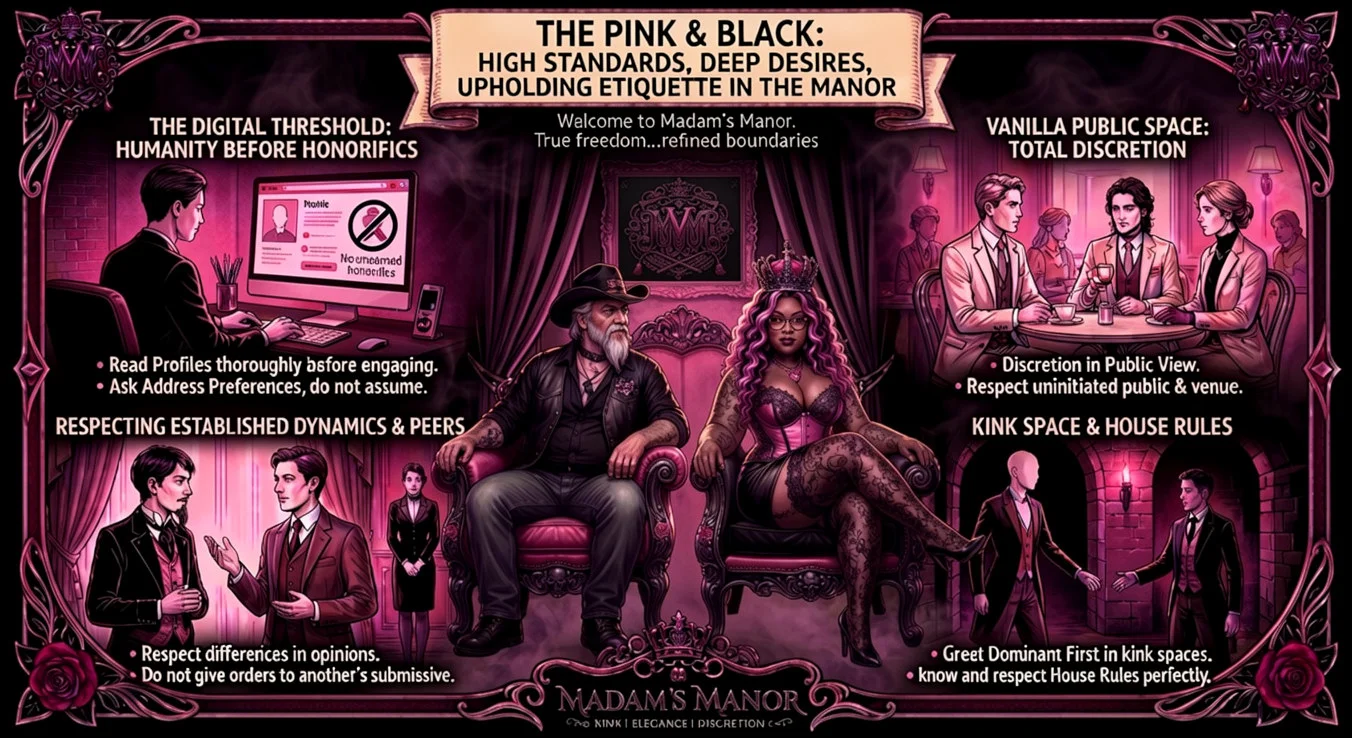
The Digital Threshold: Humanity Before Honorifics

In the modern world, the threshold of the Manor often extends into digital spaces. As Madam noted, the online landscape is frequently a minefield of entitlement and a jarring lack of basic human decency. It is astonishing how many individuals enter an online space treating it like a playground stripped of real-world consequences, reducing complex, human dynamics to a collection of demanding, transactional buzzwords.
When I first approached Madam, I saw the person before the Dominant. True digital etiquette begins long before you ever type a single syllable in a private message.

  • Do the Homework: You must read the profile. If you cannot take the time to absorb the boundaries they have explicitly laid out, you have no right to demand a moment of their time.
  • The Grace of Address: Never assume an honorific. I made it my absolute priority to explicitly ask Madam how She preferred to be addressed, ensuring I never forced a title upon Her that She had not chosen to claim.
  • A Real Conversation: Entitlement is the death of connection. Approach with kindness, check in with genuine human concern, and remember that a Dominant is not a vending machine for your desires.


Navigating the Physical World: Reading the Room

When we transition from private or digital spaces into real-life environments, etiquette becomes a dynamic, living practice. We adapt our behavior to preserve our dignity and protect the comfort of those around us.
The Vanilla Public Space and the Munch When attending a gathering in a vanilla establishment, the primary rule of etiquette is total discretion. The uninitiated public did not consent to be a part of our lifestyle. Forcing overt behaviors into a public space is a profound breach of manners and consent. At a public munch, my protocol with Madam becomes an unspoken, invisible current. The high posture and quiet focus on Her comfort remain entirely intact, wrapped in a package that looks to the outside world like impeccable, old-world manners.
Explicit Kink Spaces and the Dungeon When we step into an explicit, closed kink space, the energy shifts and our protocol can safely lean into a more theatrical level. However, strict rules still apply:

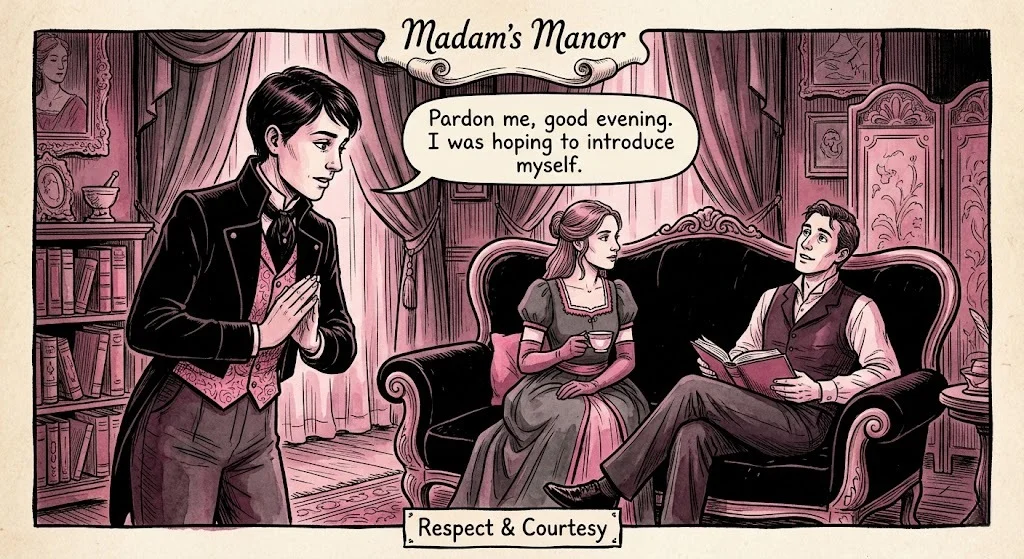
  • Greet the Dominant First: Etiquette dictates that the Dominant is always greeted first, allowing the submissive to read the room through their Dominant's reaction.
  • Know the House Rules: Every venue has its own specific expectations. To assume your personal dynamic overrides the rules of the house is the height of arrogance.

A Two-Way Street: The Symmetry of Respect

It is a common misconception that etiquette is a heavy burden borne solely by the submissive. In a truly refined dynamic, respect is entirely symmetrical.
Dominant types must possess impeccable manners if they wish to be worthy of the high standards they claim to hold. They offer their boundaries clearly, treat submissives with basic human courtesy, and take a "No" with absolute grace. Power without manners is nothing more than tyranny. Madam models this beautifully in our day-to-day life, using Her manners—a quiet please, a firm thank you—even when giving direct orders.


The Upholding of the Mandates

To keep the Manor running perfectly, Madam has laid down a clear set of expectations for how I must conduct myself. I carry these rules not as a heavy weight, but as a badge of honor:

  • Lead with Politeness and Knowledge: Offer guidance without ever appearing condescending.
  • Maintain Firm External Boundaries: Being yielding to Her does not mean being weak to the rest of the world.
  • Remain Open to Critique and Perspective: Understand that growth is a lifelong process.
  • Match Effort and Practice Patience: If someone communicates respectfully, I am to match that effort entirely.
  • Own the Mistakes: Apologize gracefully, correct errors, and move forward without ego.

Ultimately, etiquette is the elegant frame that protects the masterpiece of our deep desires. By knowing the rules of the spaces we inhabit, we ensure that the velvet curtain of Madam's Manor remains untarnished, beautiful, and absolutely pristine.


A Question for Our Guests

As we reflect on these expectations, we leave you with this thought to consider for our Saturday discussion:
In a lifestyle where roles and power exchanges can easily blur the lines of basic courtesy, what is the most important rule of etiquette you hold yourself to when engaging with someone new?


~ Madam and Her servant

1 month ago. Saturday, June 13, 2026 at 2:57 AM

Welcome to Madam's Manor. Whether you are stepping into a local dungeon for the first time or navigating the complex web of online kink communities, your behavior is your calling card. In the vanilla world, etiquette might be about knowing which fork to use. In the BDSM and kink community, etiquette is the very foundation of safety, consent, and mutual respect.


Part I: The Dominant’s Perspective
By Madam

From a Dominant’s perspective, how you conduct yourself in these spaces tells us everything we need to know about your discipline, your understanding of boundaries, and your potential as a partner. Good etiquette is deeply attractive; poor etiquette will find you swiftly ignored, blocked, or asked to leave.

The Core Tenets of Kink Etiquette


Before breaking down specific environments, you must internalize the three pillars of community protocol:


Consent is Absolute: This extends beyond physical touch. It includes emotional energy, time, and conversation.
Assume Nothing: Never assume someone's dynamic, sexual orientation, limits, or desire to interact based solely on their attire, collar, or online profile.


Respect the Dynamic: If you see two people interacting, especially if one is visibly collared or they are deep in conversation, treat their space as sacred.


Navigating the Digital Dungeon: Online Etiquette


The screen is not a shield for bad behavior. Platforms like FetLife, Discord servers, and kink-focused forums are community spaces, and treating them like a free-for-all dating app is a surefire way to be ostracized.


The "Hi, Mistress/Master" Trap: Just because an individual identifies as a Dominant or submissive does not mean they are your Dominant or submissive. Entering a direct message demanding to serve or be served, or calling a stranger by a title they haven't earned from you or permitted you to use, is presumptuous. A polite "Hello" or addressing them by their chosen screen name is the respectful baseline.
Read Before You Reach Out: Nothing exhausts people quite like answering questions that are explicitly addressed in their profile. If a profile says "Not looking for a dynamic" or "Do not DM without commenting first," ignoring those boundaries proves you lack the ability to be respectful.


The Absolute Ban on Unsolicited Imagery: Sending an unsolicited explicit photo is a non-consensual act. Full stop. It is an immediate violation of boundaries and the fastest way to get blocked and reported. Only send explicit media if you have asked, or been asked for, and received an enthusiastic "Yes."


Navigating the Physical Realm: Offline Etiquette


Offline events generally fall into two categories: Munches (vanilla meet-and-greets, usually at public restaurants) and Play Parties or Dungeons (private spaces for active scenes).

Etiquette at the Munch

  • Keep it Vanilla: Munches are often held in public spaces. Respect the venue by keeping conversations at a reasonable volume and avoiding explicit terminology or physical play that could alarm non-kink-aware patrons.
    The "Two-Drink" Rule: While having a drink to calm the nerves is fine, intoxication is the enemy of consent. Keep your wits about you.
    Do Not Out People: The person you met at a munch might be your barista or your banker the next day. Discretion is mandatory.
    Etiquette in the Dungeon
  • Look, But Do Not Hover: Watching scenes is a normal part of dungeon culture, provided the players are on an open floor. However, do not crowd the space. Keep a respectful distance, and if a Dominant or dungeon monitor asks you to step back, do so immediately.
    Never Interrupt a Scene: Unless someone is in imminent, life-threatening physical danger, never step into a scene or speak to the players. Their focus must remain unbroken.
  • Ask to Touch: This includes everything from a person's shoulder to a Dominant's flogger. The tools of our trade are personal, expensive, and often hold sentimental value. Keep your hands to yourself unless explicitly invited.

Action Do’s and don'ts

Approaching a Dominant:

  • Do: Observe them, read their profile, and offer a polite, boundary-conscious introduction.
  • Don’t: Bombard their DMs with demands to serve, extensive submissive resumes, or unsolicited pictures. 


Engaging at a Party:

  • Do: Ask, "May I watch your scene?" and respect the answer, even if it is "No."
  • Don’t: Touch equipment, offer unsolicited advice, or attempt to make eye contact with a submissive in subspace. 

Communication:

  • Do: Take "No" gracefully. A rejection is a complete sentence and requires no further justification.
  • Don’t: Whine, negotiate a hard limit, or demand a reason for why a Dominant is not interested in you. 

Collars & Gear:

  • Do: Compliment a collar respectfully if the setting is appropriate; complement knots or unique gear in the same respectful ways as a collar.
  • Don’t: Touch someone's collar or assume a collared submissive is available for play. 


From the top of the slash, leadership is a heavy mantle. Dominants are constantly assessing risk, managing safety, and guarding the well-being of those under their care. When you approach us with a solid grasp of etiquette, you signal that you are safe, self-aware, and respectful of our time and energy. 


Poor etiquette, conversely, is a massive red flag. If a newcomer cannot respect the simple boundary of "read my profile before messaging," how can I trust them to respect a safe word in the heat of a scene?


Etiquette is not about suppressing your desires; it is about channeling them respectfully. At Madam's Manor, we believe that manners are extremely important. Read carefully, speak thoughtfully, and respect the space.


Part II: A Servant's Perspective
By The Servant of the Manor

Welcome to the Manor, friends. Grab a seat, make yourself comfortable, and let’s pour a cup of tea.


As a servant here at Madam’s Manor, my days are spent observing the intricate dance of human interaction. I see the grand gestures, the quiet moments of submission, and the fierce expressions of dominance. But lately, Madam and I have been discussing a trend that’s a bit troubling, both within our walls and out in the wider world.


It seems a lot of folks are forgetting how to just be human.


Whether you are stepping into a physical kink space, navigating an online forum, or simply interacting with the wider "vanilla" world, the art of courtesy seems to be slipping through our fingers. Let’s sit down and unpack what respectful communication, genuine etiquette, and true emotional intelligence look like from a servant's perspective.

You Are a Person, Not a Caricature


The biggest misstep I see—especially from those who are new to the BDSM and kink lifestyle—is the intense urge to put on a theatrical performance. There is a broad misconception that entering this lifestyle means you must transform into a larger-than-life fictional character the moment you interact with another kinky soul.


For the Dominants, being a Master, Mistress, or Top doesn’t mean you walk into a local coffee shop—or even a dungeon—barking orders at strangers, demanding absolute fealty from the barista, or adopting a cold, robotic arrogance. For the submissives, being a servant, slave, or bottom doesn't mean you must crawl across the floor of a public munch, speak only when spoken to, or display extreme, exaggerated helplessness, unless that specific, deeply private dynamic has been explicitly established with your partner beforehand.


When you interact with the world, you must behave like a normal, well-adjusted person first. If your "role" requires you to treat others with baseline disrespect, or forces you to act so bizarrely that it makes non-consenting bystanders deeply uncomfortable, you aren’t practicing kink; you’re practicing bad manners. True power and true surrender do not require a costume or a stage play to be felt.

Don't Be a "Role" Over Yourself

There is a profound difference between embodying a dynamic and letting a label completely consume your humanity. When you try to force a "role" over your actual personality, your communication becomes rigid, artificial, and utterly exhausting for everyone around you.


Authentic authority and authentic submission don't need to be forced through a filter of stylized dialogue or strict, unyielding archetypes. They stem from deep self-awareness, emotional maturity, and mutual respect. If you are constantly policing your own speech to sound more "alpha," more commanding, or conversely, more helpless and meek, you lose the genuine human connection that makes this lifestyle so beautiful in the first place.


Relax. Breathe. Speak from your actual heart, not from a script you read on a forum or watched in a movie. The most respected Dominants and submissives in our community are those who can sit down, have a completely normal, grounded conversation about the weather, their day job, or a good book, and still carry the quiet weight of their identity without needing to perform it.


The Screen is Not a Shield

This need for grounded humanity doesn't stop when you close your front door. Whether we are rubbing elbows at a live venue or scrolling through a digital forum, the fundamental rules of decency do not change. In fact, Madam and I have noticed that the line between our physical lives and our digital ones has entirely blurred.


Unfortunately, it is remarkably easy to forget your manners when you are staring at a glowing rectangle. People who would never dream of walking up to a stranger in a bar and demanding physical service will happily slide into someone’s direct messages with an unprompted, highly explicit demand or an invasive question.


A digital profile represents a living, breathing person, not an NPC in a video game designed for your entertainment. Dropping heavy roleplay, unsolicited kink resumes, or dominant commands into someone's inbox without warning or prior conversation isn't "living the lifestyle"—it’s harassment. Digital consent is still consent. If you wouldn't say it or do it face-to-face in a crowded room with your face fully visible, do not type it under the guise of an online persona.


Differentiating Play Spaces From Hangout Spaces


One of the most frequent errors community members make, both online and off, is failing to understand the context of the room they are standing in. Not every kinky space is an invitation for kinky action. We must learn to separate environments meant for play from environments meant for connection.

  • Play Spaces: In the physical world, a play space is the dungeon floor, a private play party, or a designated backroom. Online, this equates to specific, heavily vetted roleplay channels, verified 18+ dynamic groups, or explicitly labeled adult spaces. In these areas, the lifestyle is actively practiced. Explicit negotiations, protocols, scenes, and direct lifestyle energy are expected and welcomed, provided strict, ongoing consent is maintained.
  • Hangout Spaces: These are entirely different beasts. Professionally, these are your local munches, educational seminars, book clubs, and social lounges. Digitally, these are the general chat lobbies, advice forums, meme channels, and public social media feeds. These spaces exist for building community, making friends, swapping stories, and learning.
    When you are in a hangout space, the heavy dynamic energy needs to be turned down. Treat the people around you as peers, neighbors, and colleagues, not as potential play partners or targets for your desire. A munch is not a meat market, and a community Discord server is not a catalog for finding a partner.

The Art of Reading the Room

Before a servant serves a meal, they assess the table. Is the conversation tense? Is it celebratory? What is the energy of the guests? You must apply this exact same sense of observation to your lifestyle interactions before you ever act on your wants. Before you try to show off your dominant persona, pitch yourself as a servant, or even drop a heavy topic into a conversation, take five minutes to just sit back and observe.


Look at the established culture: Every community, local munch, and online server has its own unwritten rules, comfort levels, and boundaries. Don't burst through the door trying to dictate the vibe or force everyone to adapt to your specific flavor of kink.
Check the current temperature: If an online chat or a physical circle of people is having a serious, vulnerable discussion about safety, mental health, or community accountability, that is absolutely not the moment to drop a flirtatious comment, an explicit joke, or an unprompted picture of your new impact toys.


Ask the golden question: "Is this welcome here, and is it welcome right now?" Your desires, your identity, and your kinks are completely valid, but they are not the center of gravity for the room you just walked into.
At the end of the day, courtesy isn't about hiding who you are or feeling ashamed of your kinks. It’s about having the emotional intelligence to realize that your lifestyle is a gift to be shared contextually and with enthusiastic consent, rather than a performance to be forced upon an unsuspecting audience. Let's keep our digital spaces as respectful as our physical ones, and treat every person we encounter with the dignity they inherently deserve.

Now, if you'll excuse me, Madam's glass is empty, and a servant's work is never truly done.

Until next time, The Servant of the Manor

1 month ago. Friday, June 12, 2026 at 2:05 AM

Dominant (Dom / Domme): The person who takes charge, leads the dynamic, or directs the activities. They are given authority by the submissive to set rules, administer discipline, or guide a scene.


Submissive (Sub): The person who consensually relinquishes control or power to the Dominant. They follow instructions, adhere to established rules, and trust the Dominant to guide their experience.


Switch: A person who enjoys both dominant and submissive roles. They may take on different roles with different partners, or shift between roles with the same partner depending on the scene or mood.

Top: The person who administers the action in a scene (e.g., tying the ropes, swinging the impact toy, or giving the sensation).


Bottom: The person who receives the action in a scene (e.g., being tied, receiving the impact, or experiencing the sensation).

Sadist: A person who derives pleasure (often, but not necessarily, sexual) from inflicting pain, intense physical sensation, or psychological humiliation on a consenting partner.


Masochist: A person who derives pleasure from experiencing pain, intense sensation, or humiliation.


Sadomasochist: Someone who enjoys both giving and receiving pain or intense sensation.


Brat: A specific type of submissive who playfully misbehaves, talks back, or disobeys intentionally to provoke a reaction, attention, or discipline from their Dominant.


Service Submissive: A submissive whose primary joy comes from performing tasks, chores, or acts of service to please their Dominant or make their life easier.


Rigger and Rope Bottom (or Bunny): Roles specific to bondage (like shibari). The rigger is the one who ties the ropes, and the rope bottom is the one being suspended or bound.


Primal: A play style that taps into raw, instinctual, and animalistic behaviors. Roles are often defined as "Hunter" and "Prey," involving wrestling, biting, and highly physical, non-verbal play.


Caregiver and Little (CGL / Ageplay): A dynamic focused on nurturing and regression. The Caregiver takes on a protective, parental, or guiding role, while the Little regresses to a younger headspace to experience innocence, playfulness, or care.


Slave: In BDSM, a slave is usually person who gives up total control to someone who they are in an agreed-upon dynamic and/or relationship with. The term slave is not gender specific. You can use “female slave” or “male slave” to make a distinction between genders. While all slaves are submissive, the term often implies a deeper level of authority granted to the dominant partner, sometimes called a Master.


Master: A Master accepts (or has accepted) absolute total authority and assumes ownership of a slave or slaves.

1 month ago. Saturday, June 6, 2026 at 1:59 AM

Greetings from the Manor
Welcome back to the Manor, readers. Whether you are returning to our digital halls or stepping through the gates for the very first time, we are glad to have you here.

This week, we are diving into a topic that is frequently discussed in lifestyle circles but often misunderstood: self-care. In many spaces, self-care is treated as an afterthought or a reward for good behavior. Here, we view it as a core pillar of structural stability. Today, we are pulling back the curtain on how self-care functions within a Total Power Exchange (TPE) dynamic, exploring it from both sides of the throne.

Pull up a chair, pour yourself a drink, and join us as we discuss why keeping your cup full is a fundamental protocol—for both the ruler and the servant.


Part I: The View from the Throne
By Madam


Here at Madam’s Manor, we talk extensively about the duties, structures, and quiet beauty of submission. Today, however, I want to address something equally critical to our dynamic: the deliberate preservation of the Dominant.


As the head of this dynamic, the structural integrity of our entire relationship rests firmly on my shoulders. I am the architect, the decision-maker, and the steady hand guiding the ship through calm and turbulent waters alike. It is a profound responsibility, and one that requires an immense amount of energy.

If my energy is depleted, the entire Manor feels the shift. I cannot effectively manage my servant, create educational resources for all subbies, or maintain the daily rhythm of our household if my own cup is bone dry.

Leading by Example: The Uncompromising Baseline


For a Dominant, self-care is not a luxury or a form of pampering—it is a deliberate, calculated act of maintaining authority and peace. It is how I ensure I possess the emotional and mental bandwidth to lead with fairness, clarity, and unyielding strength.
Just as I strictly require my servant to hit his hydration and rest goals, I must hold myself to an equally uncompromising baseline. Leading by example means tending to my physical vessel first.

  • Nutrition & Hydration: Eating regular, sustaining meals and drinking enough water are non-negotiable.
  • Medical Compliance: Taking my daily medications on time, every day.
  • The Mandate: These are not optional suggestions; they are the absolute bare minimum requirements to keep my mind sharp and my body capable. A healthy dynamic requires a healthy leader.

The Art of the Recharge


Beyond the physical basics, my personal self-care is a highly personalized blend of creative expression, structured organization, and intentional stillness. When the weight of leadership feels heavy, I have a specific toolkit I rely on to decompress and reclaim my energy:

  1. Creative Escapes
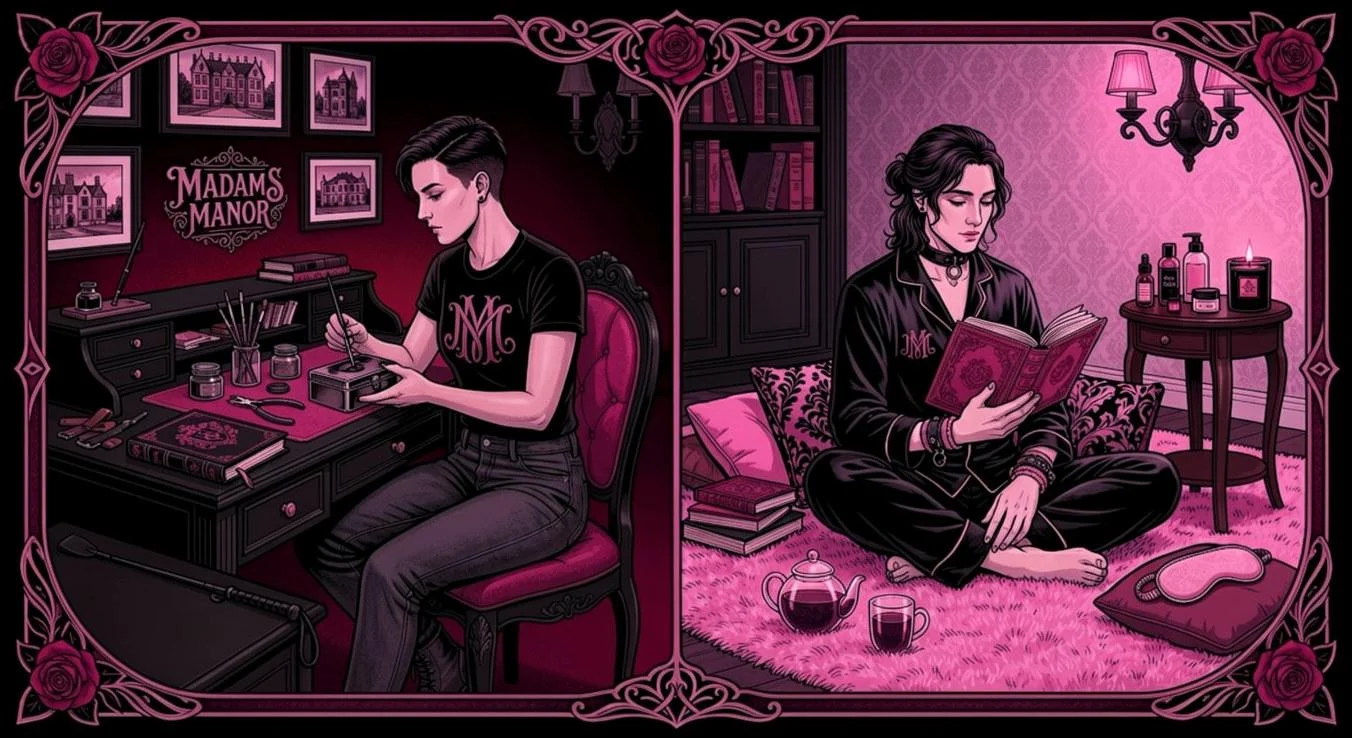
    Immersing myself in AI art generation for my character designs, writing out my thoughts for the blog, or simply sitting down to color. These outlets allow me to channel my focus into something purely creative, visually stimulating, and entirely mine.
  2. Systematizing the Chaos
    It might sound like a chore to some, but taking the time to organize brings me a profound sense of control and calm. Building out new spreadsheets, updating my daily habit trackers, or refining checklists lets me sort the noise of the world into neat, manageable boxes.
  3. Sensory Resets
    Sometimes, the best way to clear my head is to step away entirely. Smoking a cigarette while listening to music helps me detach from the immediate demands of the day and recenter my thoughts within my own private space.
  4. Meaningful Connection
    Self-care isn't always done in isolation. Chatting and spending time with my bestie fills my social cup, while enjoying quiet, unscripted downtime with my servant allows me to appreciate the dynamic we have built without actively "managing" it.

Self-care at the top isn't selfish. It is the vital maintenance that allows a Madam to rule Her Manor with a steady hand and a full heart.


A Question From Madam: To the Dominants and Leaders reading this: How do you balance the heavy weight of execution and decision-making with your own need to recharge? What non-negotiable baselines have you implemented in your own life to ensure you never pour from an empty cup?


Part II: Service from a Full Cup
By The Servant

When people hear the phrase "self-care," they usually picture candle-lit bubble baths, expensive skincare routines, or an afternoon completely unplugged from the world. And don't get me wrong—as a submissive who thoroughly enjoys a good book in a warm bath, I am certainly not discounting those moments of luxury.

But here at Madams Manor, we look at self-care through a slightly different lens.

For those of us in a lifestyle of service and submission, self-care isn’t a reward we negotiate for at the end of a hard week. It isn’t something we can casually pass on because we're "too busy." It is a fundamental, non-negotiable part of our daily protocol. It is the literal foundation upon which our service is built.

The Baseline: Care as a Command


True self-care isn’t always glamorous. More often than not, it’s incredibly basic. It’s the invisible framework that keeps a submissive healthy, grounded, and capable of giving their best to their Dominant. In our dynamic, these "basics" are treated as baseline requirements.

To give you an idea of what that looks like in practice, here is a glimpse into my own daily structure:

  • Hydration: I am required to drink a minimum of 68 oz of water per day.
  • Nutrition: I must eat at least two meals a day, ensuring at least one home-cooked meal per week.
  • Rest: A strict minimum of 6 hours of sleep per night.
  • Health: Taking all prescribed medications and vitamins daily, without exception.
  • Intake Limits: Strict boundaries on how much caffeine and sugar I am allowed to consume.

These rules aren't designed to restrict me; they are designed to protect me. They form the backbone of our dynamic. Left to my own devices, I might overdo things, run myself ragged, or forget to prioritize my own well-being. Being kept in check ensures that I remain healthy enough to fulfill my duties with a clear mind and a willing heart.

The Art of Doing Nothing


Being always at Her service doesn’t mean being constantly in motion. A crucial part of my self-care is learning how to navigate downtime.

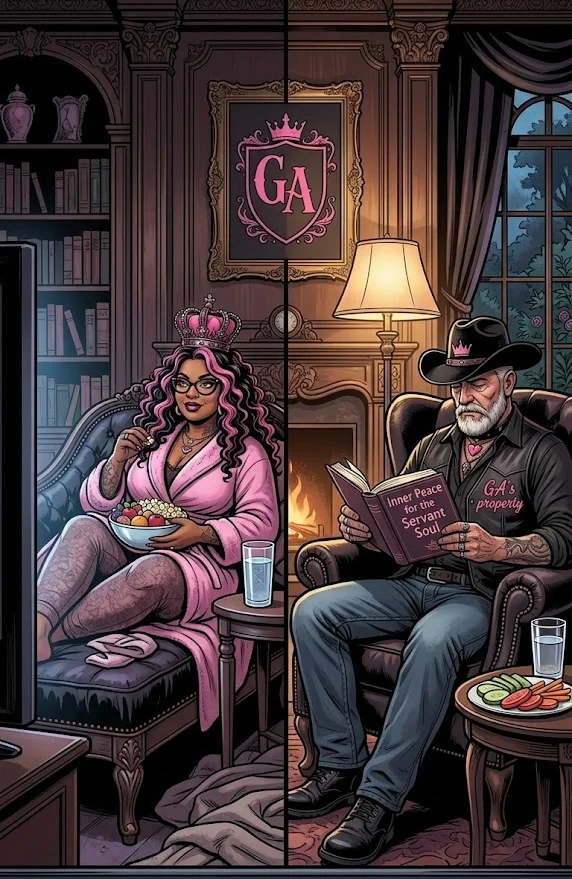
When I am not actively executing a task or fulfilling a specific command, my time is entirely my own. This is where the mental side of self-care comes into play. Whether it’s getting lost in a video game, diving into a novel, watching a favorite show, or catching up with friends, these moments of relaxation are vital.

Taking time for myself isn't a betrayal of my service; it is the recharge cycle that makes the service sustainable.


The Takeaway
If you are a submissive or a servant struggling to justify taking time for yourself, try shifting your perspective. Think of your body and mind as the instruments of your service. If you allow those instruments to rust, break, or run out of fuel, you are doing a disservice to the dynamic and to the person you serve.


Self-care isn't selfish. It's maintenance. And at the end of the day, a well-maintained servant is a happy, effective servant.


A Question From The Servant: To my fellow submissives and servants: Do you treat your own well-being as an essential protocol of your service, or do you still find yourself treating it as an afterthought? What basic, everyday rules help keep you grounded and ready to give your best to your Dominant?


~ Madam and Her servant.

1 month ago. Saturday, May 30, 2026 at 2:53 AM

Welcome back to Madam’s Manor. Today, we are turning our attention to a subject that is frequently overlooked in the shadows of dungeons and the strict protocols of our dynamics: the vital, non-negotiable practice of self-care.

In the mainstream world, self-care has been heavily commodified into bubble baths and expensive retreats. But within the lifestyle, particularly from the perspective of a Dominant, self-care is fundamentally about sustainability, safety, and preserving the integrity of your authority. We are often viewed as the unshakeable pillars in our dynamics—the ones who hold the keys, dictate the terms, and absorb the intense emotional and physical energies of our submissives. But a pillar made of neglected, weathered stone will eventually crack under pressure.

Here is a comprehensive look at why self-care is an absolute necessity for Dominants and submissives, how it protects your dynamic, and practical ways to integrate it into your lifestyle.

Why Dominants Must Prioritize Self-Care


To lead effectively, you must be operating from a place of surplus, not deficit. The role of a Dominant is inherently demanding. We are responsible for risk assessment, scene negotiation, establishing boundaries, and maintaining the emotional safety of those who submit to us. This requires extreme hyper-vigilance and emotional regulation.

When a Dominant neglects their own needs, the consequences are severe. "Top Drop" or "Dom Drop"—the physical and emotional crash that occurs after the intense adrenaline and endorphin rush of a scene—can manifest as lethargy, irritability, depression, or a profound sense of emptiness. Without a structured self-care routine, this drop can linger, bleeding into your daily life and corroding your mental health.

Practicing self-care as a Dominant is an act of ego-management and self-preservation. It is the conscious recognition that you are human, that your energy is finite, and that you must actively replenish your reserves to maintain the clarity and emotional fortitude required to hold space for another person's submission.


Securing the Foundation: Self-Care Within a Dynamic


A dynamic is only as stable as the person steering it. When you fail to care for yourself, the effects ripple directly into your relationship with your submissive. Decision fatigue is a common hazard. If you are exhausted, burnt out, or emotionally drained, your ability to make sharp, safe, and creative decisions during play diminishes. You may become reactive rather than proactive, or you might withdraw entirely, leaving your submissive feeling unanchored and anxious.

Practicing self-care within your dynamic serves two crucial purposes:

  • It guarantees safety: A rested, centered Dominant is far less likely to make a critical error during edge play, impact play, or intense psychological scenes.
  • It models healthy boundaries: When you enforce boundaries around your own time, energy, and physical space, you teach your submissive the true meaning of consent and self-respect. You demonstrate that the dynamic is built on healthy, sustainable practices rather than toxic codependency.


Dimensions of Self-Care: General vs. Lifestyle Practices


Self-care is not monolithic; it requires a multi-faceted approach. Below is a breakdown of different types of self-care, alongside concrete examples of how they apply generally and how they specifically translate into our spaces.

  • Physical Self-Care
    • Physical self-care involves honoring your body's baseline needs for rest, nutrition, and movement. It is the literal maintenance of the vessel you use to interact with the world.
  • General Practice
    • Prioritizing 7-9 hours of sleep, maintaining proper hydration, engaging in regular exercise to build stamina, and seeking medical care when injured or ill.
    • Kink-Specific Practice
        • Post-Scene Recovery: Acknowledging the physical toll of throwing a heavy flogger, suspending a rigger, or maintaining stressful postures. This means scheduling time for stretching, hydration, and physical rest immediately following a heavy scene.
        • Top Aftercare: Aftercare is not just for bottoms. Claiming your own physical aftercare—whether that means requiring your submissive to bring you water and a warm meal, or simply taking a hot shower alone to wash off the sweat and energy of the scene—is vital.

Mental and Emotional Self-Care

This type of care focuses on managing stress, processing complex emotions, and maintaining cognitive clarity. It requires actively protecting your peace.

General Practice:

  • Attending mundane therapy, journaling to process complex emotions, unplugging from social media, and engaging in hobbies that have zero connection to your primary responsibilities.

Kink-Specific Practice:

  • De-rolling: Consciously stepping out of your Dominant headspace. Taking the collar off (metaphorically or literally) and allowing yourself to just be a person, free from the demands of leadership.
  • Peer Support: The lifestyle can be isolating. Engaging with other Dominants in private groups or over coffee is essential. You need a space where you can discuss the heavy lifting of dominance with peers who understand the unique weight of the role without judgment.
    Scene Refusals: Giving yourself permission to say "no" to a scene, even if it was previously scheduled, simply because you do not have the mental bandwidth to execute it safely and enthusiastically.


Energetic and Spiritual Self-Care

Regardless of your religious beliefs, energetic self-care is about grounding yourself and maintaining a connection to your core values and inner calm.

General Practice:

  • Meditation, spending time in nature, practicing mindfulness, or engaging in deep-breathing exercises to regulate your nervous system.

Kink-Specific Practice:

  • Pre-Scene Grounding: Taking five uninterrupted minutes before a scene to center your breathing, focus your intentions, and clear away the mundane stressors of the workday before you pick up an implement.
  • Energy Cleansing: Recognizing when a scene has drawn dark, heavy, or chaotic energy into your space and actively resetting the room. This might involve opening windows, rearranging the space, or simply sitting in silence to allow the adrenaline to dissipate fully before re-engaging with the vanilla world.


True authority is not about limitless endurance; it is about profound self-awareness. Taking care of yourself is not a luxury or a sign of weakness—it is the prerequisite for wielding power responsibly. Protect your energy fiercely, so that when you do choose to share it, it is potent, deliberate, and safe.


What is one boundary you have recently implemented to protect your own energy as a Dominant, and how has it changed the way you engage with your dynamic?


The Roots Beneath the Throne: The Submissive’s Imperative of Self-Care

Welcome back to the servant's desk. Earlier, we turned our gaze toward exploring why self-care is a non-negotiable duty for the Dominant.

If dominance requires operating from a place of surplus, submission requires an unshakeable sanctuary of personal resilience. In mainstream circles, submission is too often romanticized as a passive state of giving—an endless pouring out of devotion, obedience, and energy. But anyone who has lived this lifestyle knows that true submission is an active, high-endurance discipline. It demands profound emotional expenditure, vulnerability, and a deliberate surrender of ego. To yield safely, beautifully, and sustainably, a submissive cannot operate from a place of depletion. A broken instrument cannot play a masterpiece, and a hollowed-out submissive cannot offer authentic service.

Here is a look at the counter-perspective: why self-care is a radical act of self-preservation for the submissive, and how it protects the very heartbeat of your dynamic.

Why Submissives Must Prioritize Self-Care

To surrender control safely, you must first possess a deep ownership of yourself. Submission is not the erasure of the self; it is the intentional gifting of your focus and devotion. When you neglect your own baseline well-being, that gift becomes tarnished by exhaustion, anxiety, and resentment.

The most acute risk of self-care deficit for a submissive is "Sub Drop." This is the sudden drop in endorphins, dopamine, and oxytocin that occurs after the intense high of a scene or an extended period of dynamic focus. Sub drop can manifest as profound vulnerability, irrational crying, feelings of abandonment, or an existential fog. Without a structured, personal self-care routine to anchor you, sub drop can spin out of control, causing you to misinterpret the natural emotional hangover of a scene as a flaw in your dynamic or a failure in yourself.

Practicing dedicated self-care ensures you have the emotional ballast required to weather these internal shifts without losing your footing.


Securing the Foundation: Self-Care Within a Dynamic

It is a common misconception that a submissive’s care is entirely the responsibility of their Dominant. While a good leader provides structure, protection, and aftercare, you are the ultimate custodian of your own well-being. Expecting a Dominant to anticipate and repair every emotional fracture you experience is not submission—it is toxic codependency.

Practicing self-care within the context of a dynamic is vital for two distinct reasons:

  • It Protects Your Dominant from Burnout: When you fail to care for your own mental and physical health, you inadvertently shift an unsustainable emotional burden onto your Dominant. Instead of leading, they are forced to constantly manage your crisis. By keeping yourself healthy, you ensure that your submission remains a source of joy and fulfillment for them, rather than an exhausting weight.
  • It Preserves the Integrity of Consent: A submissive who is burnt out, desperate for approval, or emotionally unraveled will often agree to scenes, protocols, or boundaries they cannot genuinely handle. True self-care gives you the clarity to know your limits, speak your truths during negotiations, and utilize your safewords or communication tools constructively.


Dimensions of Self-Care: General vs. Lifestyle Practices

Just as authority requires a multi-faceted maintenance routine, submission requires a deliberate, multi-layered approach to replenishment.

Physical Self-Care

Physical self-care means treating your body as a sacred vessel. It is the physical canvas upon which your dynamic is often expressed.

General Practice:

  • Ensuring proper sleep hygiene, nourishing your body with balanced meals, staying hydrated, and honoring physical limitations or medical requirements.

Kink-Specific Practice:

  • Active Body Recovery: Taking accountability for your physical healing after heavy impact, rope suspension, or intense sensory deprivation. This means knowing which salves, warm baths, or rest periods your body requires to mend, rather than waiting to be told to rest.
  • Vocalizing Aftercare Needs: Recognizing that your physical needs change from scene to scene. True self-care is having the self-awareness to say, "Today my body needs heavy blankets and silence," rather than silently suffering through an aftercare routine that doesn't fit the moment.


Mental and Emotional Self-Care

This dimension focuses on processing the intense psychological spaces that submission requires, ensuring that your headspace remains clear and intentional.

General Practice:

  • Engaging in professional therapy, journaling to unpack complex internal dialogues, setting boundaries in your professional life, and cultivating creative outlets.

Kink-Specific Practice:

  • De-briefing and Processing: Separating the fantasy of a scene from the reality of your day-to-day life. It means taking time to journal after a heavy session to process any lingering thoughts, ensuring that submissive headspace doesn't bleed into areas of your vanilla life where you need to remain sharp and independent.
  • Maintaining an Independent Identity: Cultivating hobbies, friendships, and intellectual pursuits that have absolutely nothing to do with your dynamic or your Dominant. A resilient submissive is a whole person who chooses to submit, not someone who relies on submission to define their entire existence.


Energetic and Spiritual Self-Care

Submission often touches on the profound, the transformative, and the transcendent. Protecting your inner peace is paramount.

General Practice:

  • Mindfulness, meditation, nervous system regulation through deep breathing, or spending time in restorative environments.

Kink-Specific Practice:

  • Pre-Scene Alignment: Taking ten minutes before a scene or a protocol shift to intentionally step out of the chaotic noise of the modern world. Grounding yourself ensures that you enter your Dominant's presence from a space of calm, deliberate intent, rather than using submission as a frantic escape from stress.
  • Reclaiming Your Center: Learning how to call your energy back into yourself after an intense period of service or subspace. This involves sitting in quiet solitude, recognizing where your Dominant's energy ends and your own begins, and anchoring your awareness firmly back into your own skin.


Submission is an art of exquisite strength, not fragile compliance. By fiercely guarding your own well-being, you ensure that the devotion you offer is sustainable, powerful, and clean.


When you look at the landscape of your current dynamic, where is the line between healthy devotion and personal exhaustion?


~Madam and Her servant.

2 months ago. Saturday, May 23, 2026 at 7:48 PM

Welcome to this Saturday’s edition of Madam's Manor.


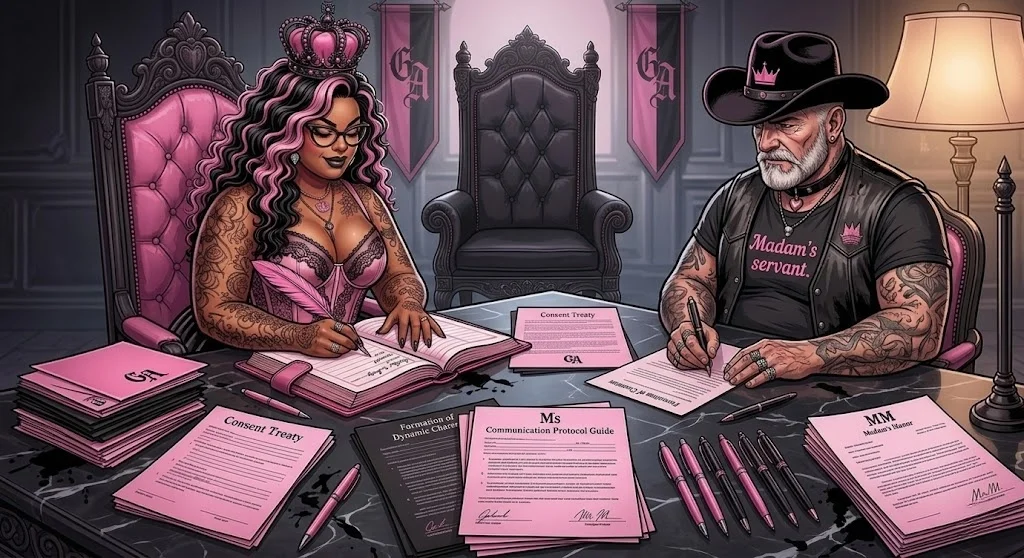
Today, we are diving into the intricate world of dynamic negotiations with our latest feature: Black, Pink, and Paperwork: The Art of Structured Communication.

Setting boundaries and establishing rules is a delicate balance of form and function. Navigating the fine print of a power exchange or outlining fresh guidelines doesn't have to be a clinical, lifeless process. It can be a high-contrast blend of authoritative structure and your signature aesthetic. The way you present your boundaries is just as impactful as the boundaries themselves. In our world, the sharp, unapologetic black of hard limits meets the vibrant, tailored pink of personalized desires—all bound together by the rigorous framework of paperwork.

Here is an inside look at how we navigate the boardroom of our dynamic, and the psychological weight behind the rules we live by.


The Madam’s POV: The Psychological Anchor

When we first formalized our dynamic, we crafted a comprehensive document—a central grimoire where our rules, protocols, rituals, and expectations are codified and kept strictly up to date. Everything within its pages was negotiated, with calculated compromises made on both sides.


A written document is far more than a chore chart; it is a psychological anchor. For my submissive, seeing the rules in stark black and white removes the anxiety of ambiguity. It answers the internal question of "How do I please her today?" before he even has to ask. For me, it is the tangible manifestation of authority. It solidifies that submission is not just a fleeting mood, but a structured, lived reality.


Rewiring the Mind Through Routine


When building the foundation of this contract, there were specific elements I was fiercely passionate about. At the forefront was orgasm denial—specifically, grueling, long-term denial and structured edging routines. I made it clear early on that this was non-negotiable. This wasn't just for my sexual gratification; it was about profound psychological rewiring.


A denied, heavily teased submissive exists in a heightened state of awareness. By acting as the sole gatekeeper of his release, I reroute his brain's dopamine-seeking behaviors. The desperation for physical climax transmutes into a desperate need for my approval. The result is a servant who is meticulously detail-oriented, hyper-attentive, flawlessly obedient, and deeply thoughtful.


I also outlined specific physical positions he must know, including when and how to utilize them. What started as one formal bow a day has escalated to a minimum of one to three, excluding any impromptu positions I demand. Muscle memory is incredibly powerful: when the body habitually lowers itself, the ego naturally follows.


Furthermore, I strictly regulated aspects of his well-being, like his caffeine intake. Total authority requires holistic ownership. Regulating his stimulants allows me to control his nervous system and energy spikes, reinforcing that his optimal health belongs to the Manor, not his passing whims.


The Art of Calculated Compromise


Authority without flexibility breeds resentment. During negotiations, we found middle grounds on:

  • Ruined orgasms versus full orgasms
  • Adjustments to physical positions to account for bodily limits
  • Required daily/weekly edging quotas
  • Permitted smoking frequency

In a dynamic, compromise is not a concession of power—it is calculated benevolence. A submissive who feels heard and safe is far more willing to surrender completely to the heavier, darker aspects of the dynamic. Finding compromise introduces a variable reward schedule into his psychology, keeping him eager and deeply invested. It requires intense communication to strike that perfect, moody balance where my authority remains absolute, but his fundamental limits are respected.


The Living Contract

Dynamics are not set in stone, they grow, change, and evolve. Every couple of months, we sit down, pull up the document, and dissect it. We refine, eliminate, and add. Beyond scheduled reviews, either of us can spontaneously bring a clause to the table. Stagnation is the death of passion, and scheduled renegotiations prevent silent resentments from festering. During these meetings, we operate under one strict understanding: words, wording, and specificity matter. Precise language eliminates loopholes, reduces anxiety, and ensures my expectations are crystal clear.


From the Desk of the Servant: The Living Ink


In Madam’s Manor, we talk a lot about the aesthetic—the beautiful contrast of black and pink. But beneath that visual elegance lies the functional foundation: the paperwork. If Madam is the architect of our dynamic, I am the lived-in reality of those walls. While She paints with bold strokes of authority, I am the one walking the corridors, finding the rhythm in her rules.


When Madam first approached me, it wasn’t with a thunderclap of total ownership. It started as an act of grace. She stepped into a space that wasn’t even hers to manage yet, offering structure to a submissive who was untethered and struggling. She honored a commitment that wasn't originally hers, building the very first layer of trust.


Back then, the paperwork was just a series of conversations about hard lines. But as our connection deepened, the "help" morphed into ownership. I remember asking early on if She utilized contracts. She was playfully modest, suggesting it wasn't exactly her style. Looking at the living, breathing document that governs our life today, it’s clear just how delightfully wrong she was.


The Evolution of the Leash


We didn’t tumble into a Total Power Exchange overnight. It was a deliberate, steady climb. By the time I finally pressed my leash into her hand, we had already weathered countless lists of kinks and debated the nuances of our terminology. We chose to start exactly as we intended to carry on, treating the foundation with the seriousness of a legal oath.


But the most important lesson I’ve learned? The ink on these pages is never truly dry.


Rules are not stone tablets. A dynamic that doesn’t change is one that has stopped growing. We’ve navigated shifts in our chemistry, adjustments to my caffeine intake, the evolving cadence of my bows, and delicate recalibrations of orgasmic protocols. Some rules that were once rigid have softened, while new, more complex structures have taken their place.


The Dance of Renegotiation


I find profound security in knowing our document is a conversation, not a cage. If a protocol chafes or a ritual loses its resonance, I can approach Madam with the truth. We sit down, review the text, and adjust. Admitting something isn't working isn't a failure—it is the very definition of success.


Conversely, when Madam introduces a new requirement, it isn't an arbitrary whim. It’s a calculated piece of our dance. We discuss the how and the why until its implementation feels as natural as breathing. A healthy dynamic is the art of balancing the black and the pink, the authority and the service, all held together by the quiet, steady hand of constant communication.


For those of you drafting your own rules, remember this: the paperwork is not the end goal. The goal is the person standing across from you. Use the pen to build a structure that honors both of you, and never be afraid to pick it up again to change the lines. The best dynamics are the ones that are still being written.


Forging Something Unbreakable


We highly recommend reevaluating your own dynamic documents every few months, or as often as the shifting tides of your relationship require. A successful negotiation happens when both sides' core needs, desires, and limits are addressed. Finding a balance you can both thrive in is challenging, especially in the high-contrast early days. Friction doesn't mean you are failing; it simply means the raw materials of your relationship require the heat of communication to forge something unbreakable.


Now, we turn the floor over to you: What is one rule or ritual in your own dynamic that started as a difficult negotiation, but has now become the most psychologically rewarding part of your connection?


Stay tuned and stay disciplined,

~Madam and Her Servant

2 months ago. Saturday, May 16, 2026 at 2:07 AM

Welcome to the parlor of Madam’s Manor. Get comfortable, pour yourself something to drink and snack on, and let’s have an honest conversation.

Today, we are diving into the absolute cornerstone of any healthy dynamic—a topic that is equally crucial for the commanding Dom at the head of the table and for all subbies navigating their journey. In our world, where we often play with shadows, high contrast, and intense emotional depths, clarity is the shimmering gold accent that holds the entire picture together.

Let's explore the art of the agreement from both sides of the slash.


The Architect of Submission: The Dominant Standpoint


In the halls of Madam's Manor, we often speak of authority, presence, and the weight of a command. But before a single knee is bent or a collar is fastened, there is a process far more vital than the act of submission itself: Negotiation.

From a Dominant’s perspective, negotiation isn’t a hurdle to get over so we can "get to the good stuff." Negotiation is the good stuff. It is the blueprint. It is the foundation upon which trust is built. Without it, you aren’t a Dominant; you’re just someone making demands of a stranger.

Whether you are stepping into a fresh dynamic or maintaining one that has lasted years, here is a guide to the art of the agreement.


The Danger of Silence: Why We Negotiate


The greatest danger in any power exchange is assumption. When a Dominant assumes they know a submissive’s limits, or a submissive assumes the Dominant will "just know" when they are overwhelmed, the dynamic becomes a minefield.

Without negotiation, you risk:

Physical Injury; Crossing a hard limit regarding safety or health.
Emotional Trauma; Triggering a past trauma that wasn't disclosed.
Resentment: A submissive feeling "used" rather than "guided" because their needs weren't met.
Dynamic Collapse: The trust shatters, and the relationship ends abruptly.


The Blueprint: Negotiations at the Start


When you first meet a potential submissive, you are interviewing each other. You are looking for compatibility, not just chemistry.

The Good Example
A Dominant presents a "Hard/Soft/Yes" list. They spend two hours over coffee discussing not just what they want to do, but why.
"I want to understand your reaction to impact. Have you ever been hit with a cane? What does aftercare look like for you when you’ve pushed your limits?"

The Bad Example
The "Vague Dominant." They focus entirely on their own fantasies and skip the details.
"Don’t worry about the details, I’ll take care of you. Just trust me and we’ll see where it goes." (This is a recipe for disaster; trust is earned through clarity, not requested through vagueness.)


The Living Contract: Ongoing Negotiations


A dynamic is a revolving door. What worked in month one might not work in year three. People grow, their tastes change, and their life circumstances shift.


The Good Example: The Quarterly Review

Every few months, the partners sit down outside of "subspace" or "D-space."
"We’ve been doing the evening protocol for a while. Is it still bringing you peace, or is it becoming a chore? Do we need to adjust the intensity of our weekend sessions?"

The Bad Example: The "Set it and Forget it"
The Dominant continues to enforce a rule that the submissive is clearly struggling with due to a change in their job or mental health, refusing to discuss it because "the rules were already set."


Forms of Negotiation


Negotiation doesn't always have to be a formal document (though contracts are excellent tools). It can take many shapes:

1. The Formal Contract: A written list of rules, protocols, and limits.
2. The Scene Brief: A 5-minute talk before a specific session focusing on immediate goals and physical status.
3. The Check-Ins: A casual conversation during aftercare or a quiet dinner to gauge the "temperature" of the dynamic.


Immediate Red Flags: When to Walk Away


If you are a Dominant looking for a submissive (or vice versa), watch for these red flags during the negotiation phase:

The Limit-Pusher: If they try to talk you out of a hard limit before the dynamic even starts (“Are you sure? I think you'd actually like it if I did it right...").
The Safe-Word Denier: Anyone who suggests that "real" submissives don't need safe words or that they "won't let you use it."
The "Rushing" Party: Someone who wants to skip the talk and go straight to the bedroom/dungeon.
The Omission: Someone who purposefully hides health conditions or mental health triggers.


What to Negotiate (and What is Non-Negotiable)


Negotiate These:

Protocols: How to address each other, morning/evening routines, and dress codes.
Activities: Impact play, breathwork, bondage, etc.
Frequency: How often you meet or communicate.
Aftercare: What specific actions provide the most comfort after a scene?
Discipline: What happens when a rule is broken?

Do NOT Negotiate These:

Consent: Consent is the floor, not the ceiling. It is never "negotiable" to bypass it.
Safe Words: The existence and absolute power of a safe word is a fundamental law.
Basic Human Rights: Access to food, water, sleep, and medical care (unless specifically, safely, and temporarily negotiated for a high-protocol scene with strict oversight).
External Responsibilities: A dynamic should generally not interfere with a person’s ability to work, parent, or maintain their health.


The Voice in the Silence: The Submissive Standpoint


Establishing a power exchange is often likened to a dance, but for those of us who walk the path of submission, it is more like building a sanctuary. We provide the space, the devotion, and the surrender; however, that sanctuary can only stand if the foundation is reinforced with honesty.

While our Dominants may act as the architects, we are the ones who must live within the structures they build. Therefore, negotiation isn't just a "safety check"—it is our most vital contribution to the dynamic.

In the refined atmosphere of Madam's Manor, we understand that true submission is never the absence of a will; it is the conscious, informed gift of it. To give that gift safely, we must master the art of the "Before," the "During," and the "Always" of negotiation.


The Danger of the "Silent Submissive"


There is a common myth that the "perfect" submissive has no needs, no limits, and no voice. This is not only false—it is dangerous. When we fail to negotiate, we aren't being "easy"; we are being reckless.

Without clear negotiation, we risk:

The "Mask" Slip: You pretend to be okay with something to please your Dominant, only to have a breakdown three weeks later because you reached a breaking point you never disclosed.
Sub Drop: Without a negotiated aftercare plan, the chemical "crash" after a scene can feel like a dark, bottomless pit of depression.
Loss of Self: Without boundaries, submission stops being a beautiful role and starts being an erasure of your personhood.


The Interview: Setting the Foundation


When first meeting a potential Dominant, your goal isn't just to be "chosen"—it's to see if they are worthy of what you are offering.

The Good Example: The Vulnerability Audit
A submissive comes to the table with a clear understanding of their "why."
"I crave impact, but I have a history of shoulder injuries. I need to know that you will prioritize my physical longevity over a moment of intensity. Also, I struggle with 'dropped' communication; can we negotiate a daily check-in protocol to keep me grounded?"

The Bad Example: The "People-Pleaser"
A submissive is so eager to please that they mirror the Dominant’s desires.
*Dom:* "I'm into heavy breathplay."
*Sub:* (Internal: That scares me.) "If that’s what you like, I’m sure I’ll love it too. I just want to make you happy." (This is a lie that will eventually lead to trauma.)


The Maintenance: Keeping the Dynamic Healthy


Negotiation doesn't end when the collar is buckled. A dynamic that doesn't evolve will eventually suffocate.

The Good Example: The "Traffic Light" Review
The submissive initiates a check-in regarding a specific rule that has become a burden.
"Sir, the protocol of me being dressed and ready by 6:00 PM was wonderful when I was working from home. Now that my commute has changed, it’s causing me high anxiety instead of peace. Can we renegotiate the timing so I can still serve you without feeling frantic?"

The Bad Example: The "Martyr"
The submissive feels the dynamic is no longer serving their needs but stays silent because they think "enduring" is part of their service. They grow resentful, and eventually, the dynamic implodes because they "suddenly" quit.


Different Forms of Negotiation


Negotiation is a spectrum of communication, ranging from the technical to the emotional:

The "Hard/Soft/Yes" Document: A physical or digital list that clearly categorizes activities. (Essential for new dynamics).
The Safeword Drill: Periodically testing a safeword in a low-stakes environment to ensure the Dominant will stop instantly.
The "Vibe Check": A post-scene discussion focusing on the emotional landscape. ("When you said X, I felt small in a way I didn't like. Can we adjust that phrasing?")


Immediate Red Flags: When to Close the Door


If you are negotiating and encounter these behaviors, do not proceed. Your safety is at stake.

The "Ego Trip": If they react to your limits with annoyance or try to shame you for having them (*"A real submissive wouldn't be afraid of this"*).
The Information Withholder: If they refuse to tell you their real name, their experience level, or their health status while demanding total transparency from you.
The "Consent Blurrer": If they suggest that "implied consent" covers things you haven't explicitly discussed.
The Safety-Word Dismissal: If they joke about ignoring your "Red" or suggest that "No means Yes" in their dungeon. Run.


What to Negotiate (and What is Sacred)


Negotiate These (The "Living" Items):

The "Aftercare Menu": Do you need to be held? Do you need sugar? Do you need to be left alone in a dark room?
Digital Presence: Are photos allowed? Are they kept on a private server?
Financial Boundaries: If the dynamic involves gift-giving or "fin-dom" elements, what are the hard budget caps?
Language: What titles are used? Are there words that are "Hard Limits" due to past trauma?


Do NOT Negotiate These (The "Sacred" Items):

Your Right to Say "Red": The safeword is the ultimate power. It is never up for debate.
Personal Sovereignty: Your right to go to work, see your family, and maintain your physical health is the floor. A dynamic should enhance your life, not dismantle it.
Honesty: If a partner lies during negotiation about their health or experience, the dynamic is built on sand. It cannot be saved.


Closing Thoughts


Negotiation is not a sign of "weak" submission, nor is it a chore that delays the real play. It is the absolute highest form of respect you can show to yourself and to the person on the other side of the dynamic. It ensures that when you finally do say "Yes," it is a "Yes" that can last a lifetime.

At Madam's Manor, we believe that the strongest chains are made of words, not steel. A Dominant who can negotiate with empathy, clarity, and firmness is a Dominant who will enjoy a deep, lasting, and safe dynamic.

Take the time. Ask the hard questions. And never assume that "silence" means "yes."

Stay safe, stay fiercely communicative, and keep building beautiful, unbreakable sanctuaries.


We would love to hear from you.

How do you prefer to handle Negotiations?

~Madam and Her servant.

2 months ago. Saturday, May 9, 2026 at 2:21 AM

Welcome to Madam's Manor.

The digital landscape is often dismissed as a place of distance—a void of screens and empty space. But for those of us who understand the true weight of presence, it is a realm of absolute, undeniable influence.

Today, we are exploring exactly how to bridge that physical gap in our latest discussion: The Virtual Throne: Making the Dynamic Felt Every Single Day.

Authority is never a passive title. It is a living, breathing energy that must radiate through every message, every directive, and every interaction. Whether you are commanding a long-distance dynamic or cultivating a standard of absolute respect, the challenge remains the same: How do you ensure your presence is inescapable, even when you aren't physically in the room?

In this post, we will dissect the mechanics of long-distance control and structure. We will dive deeply into:

  • Mastering the Mindset: The psychological foundation required to project remote authority.
  • The Art of the Pivot: Recognizing when protocols need adjusting to serve the current reality.
  • Beyond the Basics: A deep dive into the intricacies of our LDR TPE (Total Power Exchange).

Madam’s perspective 

Today, I want to pull back the curtain and share a deeply personal look into my life. We are going to explore the reality, the structure, and the heart of my dynamic. I want to talk about what it truly takes to maintain our connection, the discipline it requires, and the grace we have to give each other along the way.


Here is a look at our dynamic, from my perspective.

Beyond the Basics: The Reality of a 24/7 LDR TPE

Our long-distance Total Power Exchange (TPE) dynamic looks vastly different from most. In my experience, it’s a setup that many in the lifestyle consider uncommon, and some even view as impossible. Yet, we successfully maintain a 24/7 LDR TPE through constant connection, comprehensive visibility, and unwavering protocols.

My servant and I are on a call almost 24/7. During this time, he is visible to me, constantly watched and accountable. I, on the other hand, am visible only when I choose to be—typically during our nighttime rituals and routines, or whenever I feel my presence is required. While he already had cameras set up in his space before me, I now have full access to them. I can drop in at any time if I want a different angle, if our primary call drops, or if I need to see who is at his door.

Beyond visibility, there is a heavy emphasis on accountability. I require a daily good morning message, followed by a comprehensive report detailing how he slept, how his physical body feels, and the current state of his headspace. His day concludes with a mandatory good night message. These check-ins are non-negotiable. It does not matter if I wake up before him, go to sleep early, or if I am pulled away by other duties—he is required to fulfill these daily obligations without fail.

Throughout the day, he must send photographic proof of his activities, from the meals he eats to the completion of his daily checklists and chores. I keep these photos as a meticulous record, allowing me to easily track what has been accomplished and what still requires attention. The specific proof required fluctuates depending on the circumstances—whether he is just getting out of bed while I am away, or if he is heading outside to do yard work.

Our protocols are definitely on the stricter end of the spectrum. We utilize three daily bows, set physical positions for various tasks, specific titles, structured apologies, and rigorous scheduling. While this level of intense protocol might not work for everyone, to us, it is simply our normal. It works beautifully, and we genuinely enjoy the structure it brings to our lives.

Mastering the Mindset: Making the "Unreal" Real


Managing a long-distance relationship of any kind—especially a demanding TPE dynamic—requires a tremendous amount of understanding, compromise, thought, and care. You have to actively *make* time, truly listen, and constantly strive for balance.


I won’t sugarcoat it and say that it is easy. However, I will confidently say that with the right person, the effort is entirely worth it. One of the biggest mental hurdles I had to overcome was the pervasive stigma that "online dynamics aren't real." That kind of negativity is exactly why so many people fail before they even begin.


I am incredibly grateful that our dynamic is supported by a few logistical blessings. First, neither of us works traditional hours, and second, we share the same time zone. In the past, I have navigated dynamics across different time zones, and it can put a heavy strain on both parties. My daily life is full; I am a stay-at-home wife, a caregiver, a daughter, and busy keeping up with my dog, Oreo. Because my spouse and I have a healthy open relationship, he is fully aware of my servant, and thankfully, they get along quite well. Having that foundational harmony in my physical home makes the mental and emotional investment in my LDR possible.

The Art of the Pivot: Partnership Over Perfection


For all our structure, life still happens. There are days when we simply have to pivot away from our usual routines, tasks, and protocols. This can be triggered by any number of variables: shifts in our headspace, unexpected life events, mental health struggles, chronic illness flare-ups, or simply low energy levels.


These days happen to both of us, and when they do, our primary response is to offer reassurance and understanding. There is absolutely nothing wrong with either of us needing a down day. I do not expect him to be "on" 24/7, just as he does not expect it of me.


This dynamic is more than just a Domme/sub relationship; it is a *partnership* before all else. Whether a pivot requires a brief, short-term adjustment or a long-term change to our rules, we implement it without making the other person feel guilty. The goal is always to ensure the other feels cared for, respected, understood, and safe.


Over the nearly two years we have been building this relationship, there have been countless evolutions. We have retired protocols he was burning out on, implemented new ones when I saw a need for more structure, and added new routines he designed specifically to care for me. Rules have been temporarily suspended, entirely rewritten, or permanently scrapped. Growth requires change. He will be providing some specific examples of these pivots for all of you lovely residents of the Manor soon.

A Final Thought:

Always remember that in any long-distance relationship, there is a real, breathing person on the other side of your screen. They have real feelings, real issues, and a real life they are navigating. Be kind, be thoughtful, communicate openly, and put in the effort. If you can do that, you too can grow something wonderfully beautiful.


I’d love to hear your thoughts in the comments:

  • What is something you think is a struggle for you in an LDR?
  • What is something you think helps you in an LDR?

~The Madam of the Manor.

The Weight of the Gaze: Life Beneath the Virtual Throne


Madam has shared her perspective on the "Virtual Throne," and as the one standing—or more often, kneeling—on the other side of that digital divide, I feel it is only right to pull back the curtain from my side of the screen.

For many, a screen is a barrier. For us, it is a conduit. It isn't just about pixels and audio; it’s about the intentionality behind every bit of data sent across the wire. Here is what a 24/7 LDR TPE feels like from the servant’s point of view.

Mastering the Mindset: The Reality of Being "Watched"


In our dynamic, the "Virtual Throne" isn't a metaphor. It is a constant, tangible presence. When Madam speaks of "inescapable influence," I feel that every time I walk through my home.

The 24/7 call and the camera access she mentioned aren't just tools for surveillance; they are the architecture of my day. There is a specific psychological shift that happens when you know your space is no longer just yours. Every time I pass a camera or glance at the monitor where her presence lingers, it serves as a silent reminder of my position and my purpose.

It transforms a mundane living room into a dedicated space of service. The "unreal" becomes very real when you realize that even in the quiet moments—when no words are being exchanged—you are still held to a standard of conduct and posture. It’s the weight of her gaze that keeps the discipline sharp, even across the miles.

Beyond the Basics: The Anchor of Protocol


Madam touched on our protocols—the bows, the reports, the photographic proof. From my perspective, this isn't "extra work." They are the anchors that prevent the distance from drifting into complacency.

The Morning Report: This is my first act of service. It’s more than a status update; it’s a moment of grounding. By detailing my headspace and physical state, I am handing her the "keys" to my day before I’ve even had my first coffee.
Photographic Proof: Sending photos of my meals or my completed chores might seem granular to an outsider. To me, it is the digital equivalent of presenting my work for inspection. It’s the satisfaction of a "job well done" being acknowledged by the only person whose opinion matters.
The Three Daily Bows: These are perhaps the most vital. In a digital world, physical movement matters. Taking the time to stop, square my shoulders, and bow to the screen isn't for the camera’s benefit—it’s to remind my body exactly who I belong to.
These strict protocols create a rhythm. In an LDR, it is easy for the "lifestyle" to feel like something you only do when you're typing. These actions ensure that the lifestyle is something I am living in my physical body, every hour of the day.

The Art of the Pivot: Strength in Vulnerability


The most misunderstood part of a "strict" dynamic is often the "Pivot." People assume that TPE means being a machine. But as Madam said, life happens.

There is a unique kind of trust required to tell your Superior, "I am struggling today." When chronic illness flares or the weight of the world gets heavy, the "Pivot" is where the true depth of our bond is tested.

From my side, the Pivot isn't an "excuse" to slack off. It is an exercise in radical honesty. It’s about knowing that I can report a low-energy day or a headspace struggle or simply not feeling up to just a single specific task. Instead of a reprimand, I receive a directive that prioritizes my well-being. Whether it's shifting a chore to tomorrow or suspending a specific protocol for a few hours, this of course goes both ways, as Madam can at any time, let me know, that She needs something different or specific at a  point, or days needs to be met. these adjustments don't weaken Her authority—they reinforce it instead, with the honesty on both our parts of what is needed at the time.

A Final Reflection: The Person Behind the Protocol


Madam ended her thoughts by reminding everyone that there is a real person on the other side of the screen. I would echo that, but add this:

The effort required to maintain this isn't a burden; it’s a gift. The structure, the visibility, and the "Virtual Throne" provide a clarity that is often missing in the "real" world. I don't just see a screen; I see the path I’ve chosen to walk.

I’d love to hear from the other side of the dynamic:

  • If you are in a service role, what ritual or protocol makes the dynamic feel "real" for you?
  • How do you maintain your headspace when you are physically alone but digitally "on"?

~ The Servant of the Manor

2 months ago. Thursday, May 7, 2026 at 12:41 AM

A Note from Madam's Manor

First and foremost, we here at the Manor would like to offer our deepest apologies for the recent delay in our usual posting schedule.

An unforeseen matter arose that affected our routine, and we were unable to post as normal. While unexpected delays like this will happen from time to time, please know that we have absolutely not forgotten about you all.

Thank you so much for your patience and continued support. Without further ado, please enjoy the post that should have found its way to you this past Saturday!


The Architecture of Absence: Serving Madam from Afar


Greetings from the digital hearth of Madam’s Manor. As the one who polishes the silver—both the literal tea service and the metaphorical protocols of our dynamic—I often find myself reflecting on the miles that lie between my keyboard and Her throne.

Many believe that without physical proximity, a Power Exchange is just "roleplay." They are mistaken. If anything, a Long-Distance Relationship (LDR) within BDSM is the ultimate test of a submissive’s integrity. It is an education in mental discipline where the leash isn't made of leather, but of every honest word we’ve ever spoken.

The Foundation: The Bedrock of the Manor


Before a single task is assigned, Madam ensures our "Big Five" are structurally sound. In the Manor, distance acts as a magnifying glass; if there is a crack in your foundation, the miles will turn it into a canyon.

  • Radical Honesty: Madam cannot see my face to "read the room." If I am spiraling or overwhelmed, my transparency is my only currency. I must speak.
    The Weight of Trust: Trust is knowing that even when the camera is off, the expectations remain. It is the quiet integrity of serving when no one is watching.
  • Realistic Expectations: We cannot maintain "High Protocol" if I am working sixty hours a week. Madam’s wisdom lies in knowing when to push and when to provide space.
  • Timing: Routine is a form of worship. Our 9:00 PM "Evening Reflection" creates a tether that anchors me to Her, regardless of time zones.
  • Communication: In person, 80% of communication is non-verbal. In an LDR, we must find a way to put that 80% into our words—making the "why" more important than the "how."


The Practical vs. The Non-Practical: A Study in Sustainability


In the heat of New Relationship Energy (NRE), it is tempting to dream up cinematic scenarios. However, true growth happens in the mundane. Here is how we contrast the sustainable path with the path to burnout.

The Practical (Sustainable Service)

  • Verifiable Tasks: Writing lines, holding a wall-sit on camera, or stripping specific privileges.
  • Digital Servitude: Managing Her calendar, researching travel, or ordering Her favorite coffee.
  • App-Controlled Devices: Using Bluetooth locks with scheduled hygiene breaks and photo logs.
  • Scent & Touch: Mailing a worn shirt or a specific oil to ground the submissive in Her reality.

The Non-Practical (The Burnout Path)

  • Unmonitored Self-Harm: "Whip yourself 50 times." It’s unsafe and lacks a Dominant’s oversight.
  • General "Cleaning": "Clean your house for me." Without Her there to enjoy the space, it’s just a chore.
  • "Forever" Chastity: Locking a submissive and "forgetting" the key. This leads to infection and resentment.
  • 24/7 Open Cam: Expecting a submissive to be on camera while working or sleeping. It ruins productivity.

The Flow of Authority: A Back-and-Forth


Serving Madam isn't a monologue; it is a rhythmic exchange. It looks something like this:

The Servant: "Madam, I am feeling a sense of drift today. The distance feels heavy, and my focus at work is wavering."

Madam’s Directive: "Then you shall refocus your energy into my service. By 6:00 PM, I require a researched itinerary for my weekend in Paris—flights, three dinner options, and a gallery visit. This will remind you who you work for."

Why does this work? It replaces my aimless anxiety with structured devotion. It is a targeted task that directly benefits Her, making me feel useful even from a thousand miles away.

Discipline and the "Why"
When I fail a protocol, the "punishment" must reflect the Manor’s values.

The Non-Practical Contrast: A Dominant demands I write "I must obey" 1,000 times while I’m in the middle of my Master’s degree finals. This is "busy work" that creates resentment rather than reverence.

The Practical Example: Madam recognizes my lack of punctuality. She requires me to hold a stress position on a video call while She reads Her book. She can monitor my breathing and physical distress safely in real-time. It reinforces Her presence and my accountability without sabotaging my professional life.

Final Thoughts from the Footstool


In an LDR, words are your primary kink gear. Because we lack the physical aftercare of a warm embrace, we must compensate with Verbal Aftercare. We must become masters of "The Debrief," validating the effort and the presence of the other through clear, affirming communication.

To my fellow submissives: Your service doesn't end because there is a screen between you. If anything, your attention to detail must be sharper. Your word is the only thing She can feel from across the miles. Make sure it carries weight.


In humble service,

The Servant of Madam’s Manor


How has distance reshaped the way you communicate your needs or expectations within your own dynamic?