I'm trying to explain to people why BDSM consent structures are the answer to illocutionary colonization. The consent structures allow for somatic sovereignty.
Post at the end of the definitions:
The consent structures allow for illocutionary sovereignty:
Illocutionary Sovereignty (il-lok-yoo-SHUN-air-ee SOV-rin-tee /ɪˌlɒk.jʊˈʃʌn.ər.i ˈsɒv.rɪn.ti/)
Definition
The right and capacity of a speaker to retain ownership of their intended meaning — to have their illocutionary act received as issued, not substituted. The condition in which meaning travels from speaker to recipient without colonization.
Theoretical Lineage
Inverse of illocutionary colonization. Draws on frameworks of sovereignty in political philosophy and indigenous studies to examine the speech act. Connects to epistemic justice and communicative autonomy.
Context of Coinage
Developed as the affirmative counterpart to illocutionary colonization. Phillips identified that naming the violation was insufficient without naming the right being violated. Illocutionary sovereignty is both the theoretical object of protection and the condition the Rebellion of Light project seeks to install.
Distinction from Adjacent Terms
Distinct from free speech (a legal/political concept about permitted utterance) and communicative competence (a linguistic concept about ability). Illocutionary sovereignty is about the phenomenological and ethical integrity of meaning in transit.
And then we need to define sovereignty to make it possible to understand my meaning.
Sovereignty (SOV-rin-tee /ˈsɒv.rɪn.ti/)
Definition
The only one with say-so over what you mean. In the context of illocutionary sovereignty, the speaker occupies the apex of interpretive authority over their own speech acts — not as positional dominance over another party, but as ontological integrity of meaning in transit. The self is not above the self; the self is the above.
Etymology
From Middle English sovereynte, from Old French soverain — “highest, supreme, chief” — from Vulgar Latin superanus, meaning “chief, principal,” from Latin super (“over”), rooted in PIE *upér — “above, over.” The entire etymological lineage is vertical: positional dominance encoded at the root. The Westphalian political apparatus — sovereignty as state authority over territory, codified in 17th-century international law — represents a hierarchical institutional appropriation of a root that in its PIE form carried only spatial meaning: above. Illocutionary sovereignty performs a deliberate etymological inversion, redirecting *upér from dominion over others toward integrity of self. The elevation is inward. Analogous to arriba in Spanish, from Latin ad ripa (“to the bank, to the shore”) — a directional root socially repurposed into pure celebratory elevation. The word retains its upward vector. What it points at changes.
Distinction from Political Sovereignty
The standard contemporary definition — the supreme, absolute, and uncontrollable power of a state to govern itself without foreign interference — is the Westphalian corruption, not the PIE root. Critics who read illocutionary sovereignty as a claim of dominance are reading through the lens of Westphalia. Phillips’s use restores the pre-political spatial function of *upér: above as positional integrity, not positional dominance over another. The speaker is not sovereign over the exchange. The speaker is sovereign over their own meaning within it.
Ok- now that you have my definitions....
Oh, PIE is Proto-Indo-European
I would love to get some views on my definitions, and others' views on the necessity of understanding our own actions. And how we each use what we were taught. Utilizing those things that abused us. I'm not talking about those who consent to having their words removed. Or the times we want to be seen or something like objectification. I don't want to be objectified….I have no other word for it, though. Perhaps it is sexualized. Yes, that still carries the negative connotations I am looking to avoid, because they are not apropos to the feeling and what I'm talking about. I think I do mean sexualize because I taught myself to de-sexualize myself. I wore clothes that hid any figure I had. Never show cleavage; don't look like that. Make sure your look doesn't invite rape. As though the times it happened to me were my fault. The victim-blaming and misogyny we are taught as children sticks with us. Whether we want it to or not. Whether we know it or not, it's still there. An undercurrent of nastiness toward women. So I desexualized myself.
Now, at 54, I'm having to re-sexualize myself in a way that is healthy. I really don't like that term...Sexualize... it is accurate, I believe. Perhaps I should take the time to fully define that... sexualize...
We will start with Google...Sexualize: "to view, portray, or treat someone or something in a sexual manner, or to endow an object or concept with sexual meaning." That is from a basic Google search. I don't like the term because it inserts the idea that sexual is something added later to humanity, and while we are unready as children, we are still sexual. Not pedophilia...I'm talking self-discovery and the want to make that button go off. It happens at different ages for different people. The sex is already there. It shouldn't be acted on by another person; however, it IS there. Its existence is my only point here. If you are mistaking my words and thinking I mean children should have sex, you are sorely mistaken. I'm not talking about abuse. Understanding that sex is a preexisting part of us allows the understanding that those who are of a different persuasion are natural
I'll set that down now... please, if you have questions or doubt my meaning, write to me. Ask me. Understand me.
Somatic sovereignty- something I've not had. Not because my husband and Dom (Same man) ever took that from me...others did. They did this by using every gaslighting trick in the book, including one I named. I was taught I was evil for being abused. That it was me sexualizing myself that caused the sexual assaults and trafficking when I was young. I don't believe that consciously...but subconsciously I know the control mechanism is still there. Unwound and ready for composting emotionally, but there nonetheless.
As I spoke with HummahKavoola today on this subject, we had a great conversation about the memory of where I decided, specifically, to stall any thought of sex in my head. And I worked for that. Until it became a natural feeling. A habit, difficult to give up. A PTSD response stuck that I'm trying to desensitize myself to. A response that makes it difficult to sexualize myself because of. I was beaten as a child, as many of you know. From birth, in fact. Then I was molested, then trafficked, then raped twice to my memory. And the simple fact that I have to account for the fact that a drugging could have worked and I don't remember it is difficult to accept. Yet it is as it is, and there is a part of me that doesn't want to feel the uncomfortable thought that it could have happened without my memory. Admittedly, it isn't easy remembering that I was drugged and raped. However, I'd rather remember than not know.
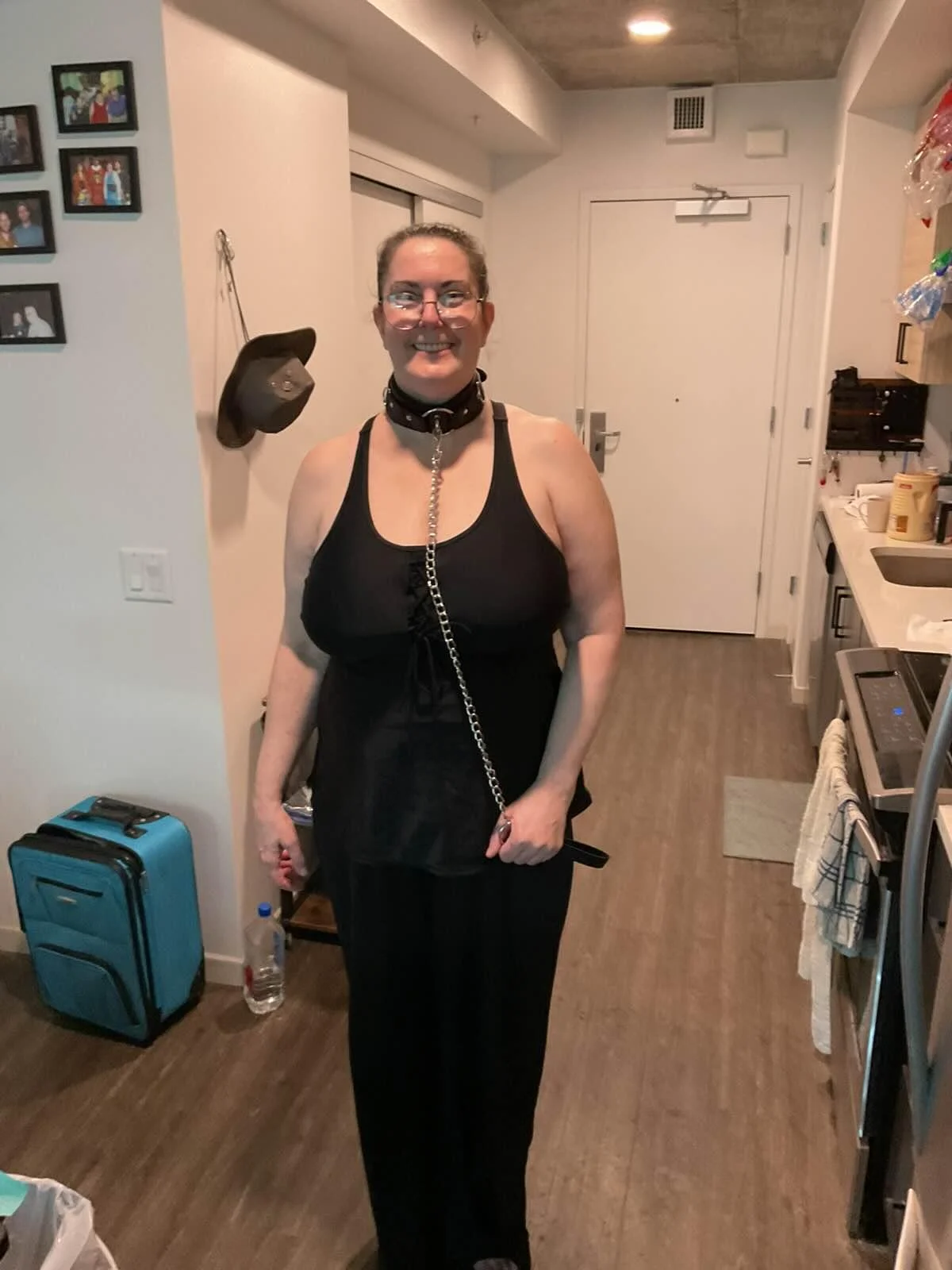
Yes, I go through this every time, every time I want sex. Every time I want anything to do with sex, I end up with the adrenal response of the memories. I am currently simply intellectualizing to view the doubt and the damage honestly. How can you salve a wound if you can't see it all? At least now... at age 54, I am starting to come out the other side of these damages. Funny...the discussion with HummahKavoola produced a healthy sexualization of self. I have done all the things I can to be considered ugly or unwanted. On purpose. I still won't leave the apartment in what I'm in now. The photo sucks, but it gives you a sense of how I've had no somatic sovereignty. It was conscripted by men, and I've only recently gotten it back. Or I'm taking it either way; my possession of somatic sovereignty is now making others mad. And this is the circle of the conversation.
He asked me what about the internet. And I said that is proudly me. Then he said, "Carry a weapon and just be. That's sovereignty," and I realized that my own sexualization had been stripped from me. Not in any permanent fashion, but stripped nonetheless.