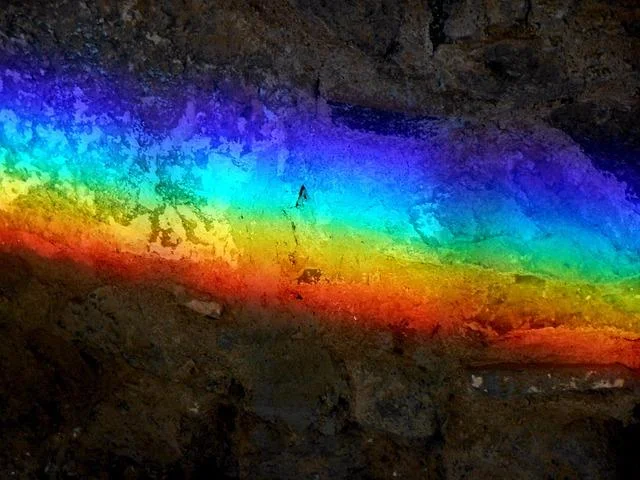
Not all colors in the mediums that artists use occur naturally. This AI explanation excerpt explains it well:
Several artist colors and perceived hues do not exist within the physical light spectrum (the rainbow of colors produced by a prism). These are known as extra-spectral or non-spectral colors, and they are largely created by the brain combining inputs from different receptors. Facebook +4
Magenta/Magenta-Purples: Magenta is the most prominent example. It is not found in the light spectrum because it has no single wavelength. Instead, the brain produces magenta when it detects red and blue-violet light simultaneously (effectively filling in the gap where green would be).
Purple/Violet: While violet exists at the edge of the light spectrum, the "purple" often used in art is a mix of red and blue, often considered a non-spectral hue.
Pink: Like magenta, pink is not in the spectrum; it is a mixture of red and violet wavelengths.
White: White light is a combination of all wavelengths, but white itself is not a specific color in the spectrum, but rather the presence of all colors.
Chimeric Colors: These are unusual colors that can only be seen through sensory adaptation, such as "staring at red to make the green receptors tired," leading to "greenish-red" or "yellowish-blue," which cannot exist in natural light.
"Olo": Recently reported by scientists, this is described as a vivid blue-green tone that does not exist in nature and was created to test color perception. Facebook +10
These colors are created, in part, by the human brain to bridge the gap between red and blue light, which are at opposite ends of the visible spectrum, when they are perceived together. pixabay. com