
Beyond Falling in Love
Most people are taught that relationships simply happen.
You meet someone. You feel chemistry. You spend time together. If everything goes well, love grows and the relationship develops naturally.
While attraction may happen naturally, healthy and lasting relationships rarely do.
Strong relationships are built consciously.
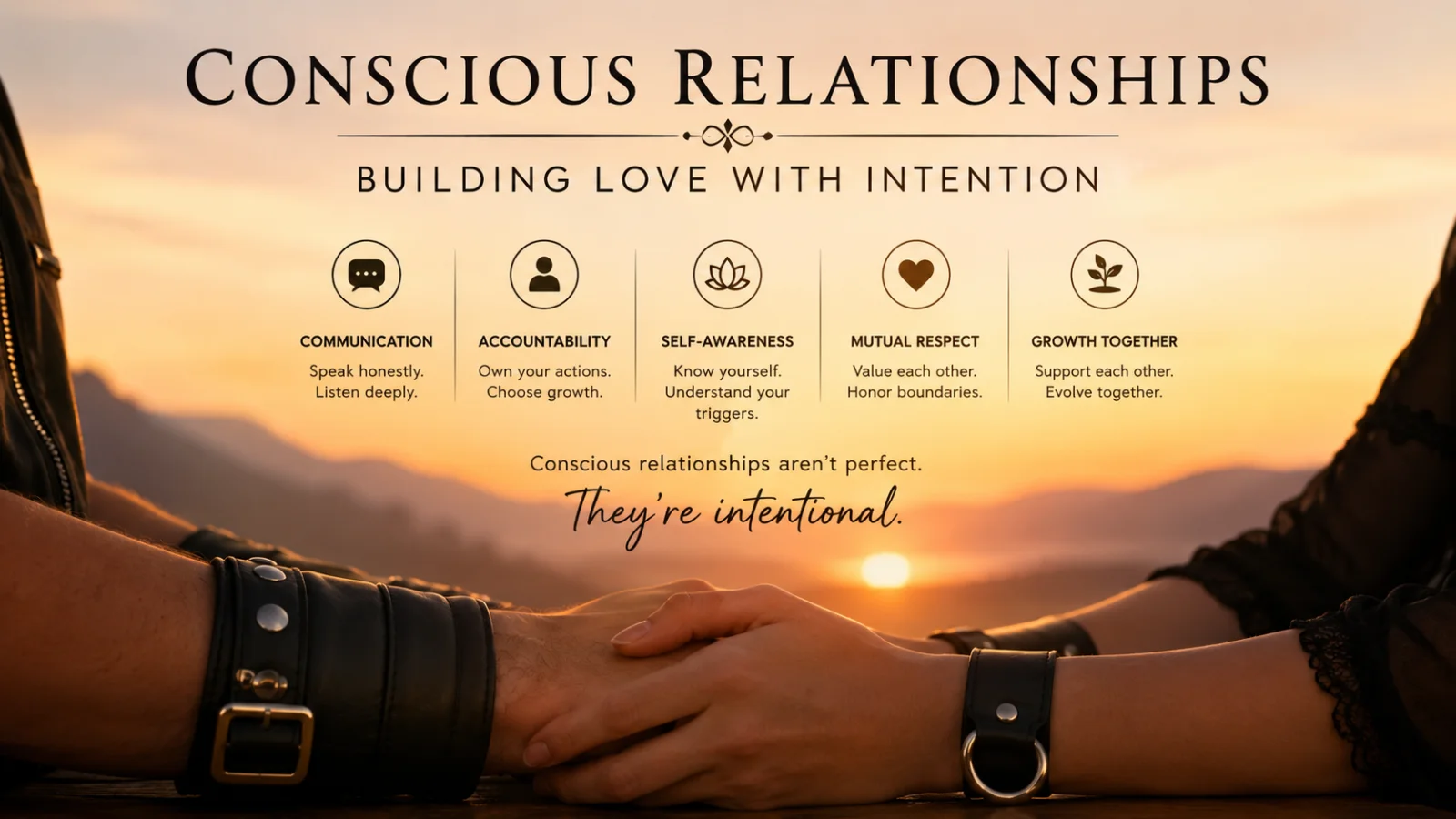
A conscious relationship is one in which both partners intentionally create the dynamic they want rather than simply reacting to circumstances as they arise. It is a relationship built on awareness, communication, accountability, and mutual growth.
Instead of asking, "What can I get from this relationship?" conscious partners ask, "What can we create together?"
What Is a Conscious Relationship?
A conscious relationship is not a perfect relationship.
Disagreements still happen. Mistakes are still made. Life still presents challenges.
The difference is that both partners choose to approach those challenges with awareness rather than avoidance.
Conscious partners understand that relationships are living systems that require care, attention, and regular maintenance.
They recognize that every interaction is an opportunity to either strengthen or weaken the connection they share.
Rather than blaming, shaming, or withdrawing, they seek understanding.
Rather than trying to win arguments, they work to solve problems.
Rather than expecting their partner to meet every need automatically, they communicate those needs clearly and respectfully.
The Pillars of Conscious Relationships
Communication
Communication is more than talking.
It is the ability to express needs, desires, fears, concerns, and expectations honestly.
Healthy communication requires both speaking and listening.
Many conflicts occur not because people disagree, but because they feel unheard.
Conscious partners listen to understand, not simply to respond.
Accountability
In unconscious relationships, mistakes often become opportunities for blame.
In conscious relationships, mistakes become opportunities for growth.
Accountability means taking ownership of your words, actions, and behaviors without making excuses.
It means being willing to say:
"I was wrong."
"I hurt you."
"How can I make this right?"
Accountability builds trust because it demonstrates emotional maturity.
Self-Awareness
Every person brings their own experiences, fears, wounds, and expectations into a relationship.
Conscious partners take responsibility for understanding themselves.
They examine their triggers.
They question their assumptions.
They recognize when past experiences are influencing present reactions.
The better we understand ourselves, the better we can understand our partners.
Mutual Respect
Respect is often confused with agreement.
The truth is that you can disagree with someone and still respect them.
Respect means valuing your partner's thoughts, feelings, boundaries, and autonomy.
It means recognizing that your partner is not an extension of yourself but an individual with their own needs and experiences.
Without respect, trust cannot thrive.
Conscious Relationships and Growth
One of the greatest gifts of a conscious relationship is growth.
Relationships act as mirrors.
They reveal our strengths, weaknesses, insecurities, and opportunities for improvement.
This can be uncomfortable.
Growth often requires vulnerability.
It requires examining patterns that no longer serve us.
It requires choosing courage over comfort.
Yet this is where the deepest intimacy develops.
When two people commit to growing together, they create a partnership capable of weathering life's inevitable challenges.
Conscious Relationships in D/s Dynamics
Conscious relationships are especially important within Dominant/submissive dynamics.
Contrary to common misconceptions, healthy power exchange requires more communication, not less.
Consent must be informed and ongoing.
Expectations must be discussed.
Boundaries must be respected.
Responsibilities must be understood by both parties.
A conscious D/s relationship is not about control for the sake of control.
It is about creating a dynamic that benefits both individuals while honoring their needs, desires, and goals.
The strongest dynamics are built upon trust, transparency, and intentionality.
Power exchange without consciousness becomes dangerous.
Power exchange with consciousness becomes transformative.
Daily Practices for a Conscious Relationship
Conscious relationships are built through consistent action.
Consider implementing:
Daily check-ins
Weekly relationship discussions
Honest conversations about needs and expectations
Expressions of gratitude
Conflict resolution focused on solutions
Shared goal setting
Intentional quality time
Small acts performed consistently often create greater results than grand gestures performed occasionally.
Final Thoughts
Love may bring two people together, but consciousness is what helps them stay connected.
A conscious relationship is not about perfection.
It is about intention.
It is about choosing each day to communicate, grow, listen, support, and love with awareness.
Whether you practice a traditional relationship, a D/s dynamic, a polyamorous structure, or any other form of consensual partnership, the principles remain the same.
People before protocol.
Trust before authority.
Consent before everything.
When two people commit to living those principles, they create something far more powerful than a relationship.
They create a partnership built to thrive.