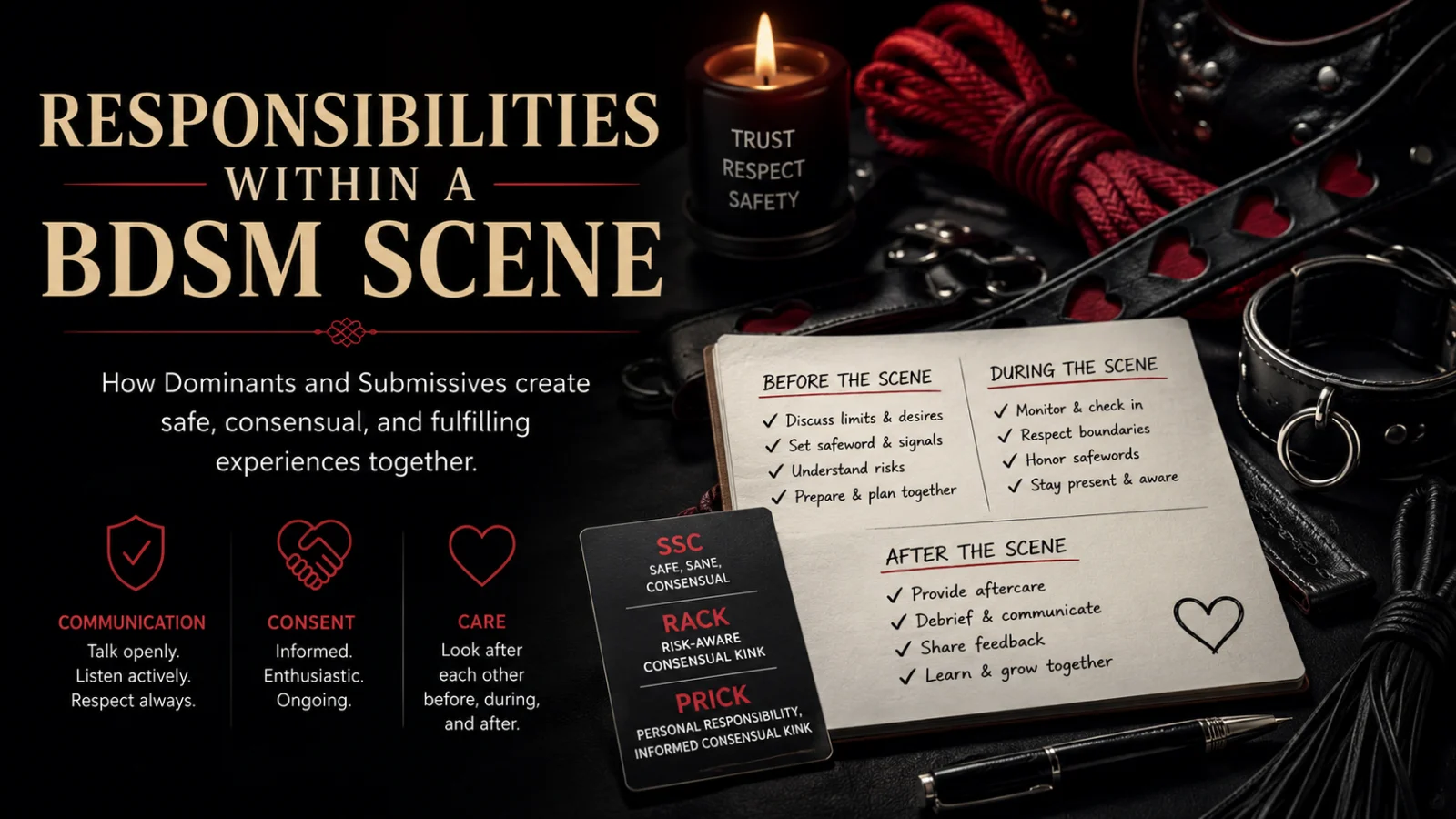

One of the most common misconceptions about BDSM is that the Dominant holds all the responsibility while the submissive simply follows. In reality, healthy BDSM dynamics require active participation, communication, and accountability from everyone involved. Whether you're engaging in a simple impact play scene, a rope session, or a complex power exchange dynamic, both partners share responsibility for creating a safe, consensual, and fulfilling experience. The foundation of every successful scene rests upon trust, communication, and informed consent.
Understanding the Shared Responsibility of BDSM
A BDSM scene is not something one person does to another. It is something two (or more) consenting adults create together. The Dominant may direct the experience, and the submissive may surrender varying degrees of control, but both individuals remain responsible for maintaining safety, respecting boundaries, and communicating honestly. This shared responsibility is reflected in several core philosophies commonly embraced within the BDSM community.
SSC: Safe, Sane, and Consensual: One of the oldest and most widely recognized frameworks in BDSM is SSC.
Safe
Participants take reasonable precautions to minimize physical and emotional risks.
Sane
All participants are capable of making informed decisions and understand the activities involved.
Consensual
Everyone freely agrees to participate without coercion, manipulation, or pressure. SSC reminds us that consent and safety are the foundation upon which all BDSM activities are built.
RACK: Risk-Aware Consensual Kink: As the BDSM community evolved, many practitioners adopted RACK as a more realistic framework. RACK acknowledges that no activity is completely without risk.
Instead of pretending activities are entirely safe, participants:
- Understand the risks involved.
- Educate themselves about those risks.
- Accept those risks knowingly.
- Provide informed consent.
RACK emphasizes personal responsibility and informed decision-making.
PRICK: Personal Responsibility In Consensual Kink: PRICK expands upon RACK by placing greater emphasis on individual accountability.
Under PRICK:
- Participants educate themselves.
- Participants disclose relevant information.
- Participants take ownership of their decisions.
- Consent is based on accurate information and understanding.
PRICK reminds everyone that personal responsibility cannot be delegated simply because a power exchange exists.
Even within the most intense Dominant/submissive dynamic, each person remains responsible for communicating honestly and making informed choices.
Consent: The Foundation of Every BDSM Scene
Before discussing the responsibilities of Dominants and submissives, it is important to understand the concept that makes ethical BDSM possible: consent.
Consent is the voluntary, informed, and ongoing agreement to participate in specific activities, dynamics, or relationships. It is the cornerstone of healthy BDSM and separates ethical power exchange from abuse.
Despite common misconceptions, BDSM is not about one person taking power from another. It is about individuals voluntarily choosing how power will be exchanged within clearly negotiated boundaries.
What Makes Consent Valid? - Informed Consent
Consent can only be meaningful when all participants understand:
- The activities being proposed
- The potential risks involved
- The physical and emotional effects that may occur
- The expectations of everyone involved
Honesty and transparency are essential. Important information should never be withheld from a partner.
Freely Given Consent
Consent must be given without:
- Pressure
- Manipulation
- Threats
- Coercion
- Fear of consequences
A person should always feel safe saying "no."
Specific Consent: Consent is activity-specific. Agreeing to one activity does not automatically mean agreeing to another.
For example:
- Agreeing to impact play does not mean agreeing to bondage.
- Agreeing to a scene tonight does not mean agreeing to future scenes.
- Agreeing to a relationship does not mean agreeing to every request.
Assumptions have no place in healthy BDSM dynamics.
Ongoing Consent: Consent is not a contract signed once and forgotten.
Participants have the right to:
- Change their minds
- Adjust boundaries
- Pause an activity
- End a scene entirely
This is why safewords and regular check-ins are so important.
Enthusiastic Consent: Many modern BDSM practitioners embrace the concept of enthusiastic consent. Rather than looking for the absence of a "no," they look for the presence of a genuine and enthusiastic "yes." The goal is not merely participation—it is willing participation.
Consent and Power Exchange: One of the most important concepts for newcomers to understand is that submission does not eliminate consent.
Even within:
- Dominant/submissive (D/s)
- Master/slave (M/s)
- Owner/property dynamics
- 24/7 power exchange relationships
Consent remains the foundation. A submissive may choose to surrender authority, but they do not surrender ownership of their body, mind, or personal autonomy. The ability to withdraw consent remains intact.
How Consent Relates to SSC, RACK, and PRICK
The philosophies discussed earlier all place consent at their core.
SSC (Safe, Sane, and Consensual) emphasizes that activities should be conducted safely, by capable participants, with clear consent.
RACK (Risk-Aware Consensual Kink) recognizes that some BDSM activities involve inherent risks and that participants knowingly accept those risks through informed consent.
PRICK (Personal Responsibility In Consensual Kink) emphasizes that every participant is responsible for educating themselves, understanding risks, and making informed choices.
Although these frameworks differ in their approach, they all agree on one fundamental truth:
Without consent, BDSM ceases to be BDSM.
Dominant Responsibilities
Before the Scene: A Dominant's responsibilities begin long before the scene starts.
They should:
- Discuss limits and boundaries.
- Establish safewords and safe signals.
- Understand medical or emotional concerns.
- Prepare equipment properly.
- Learn the skills necessary for planned activities.
A responsible Dominant never assumes they know what a submissive wants without discussion.
During the Scene
While the scene is active, the Dominant should:
- Monitor physical and emotional well-being.
- Watch for non-verbal distress signals.
- Respect negotiated boundaries.
- Honor safewords immediately.
- Maintain control without becoming reckless.
- End the scene if needed!!
Authority does not eliminate responsibility. In fact, it increases it.
After the Scene: Aftercare is often one of the most important parts of a BDSM experience.
Depending on the individuals involved, aftercare may include:
- Physical comfort
- Reassurance
- Food or hydration
- Blankets or warmth
- Emotional support
- Quiet connection
A Dominant should also encourage discussion about the scene and remain open to feedback.
Submissive Responsibilities
Before the Scene: A submissive's responsibility begins with honesty
This includes:
- Communicating limits clearly.
- Discussing fears and concerns.
- Disclosing relevant medical issues.
- Avoiding the temptation to agree simply to please someone.
Consent is meaningful only when it is informed and voluntary.
During the Scene
A submissive should:
- Communicate when something is wrong.
- Use safewords when necessary.
- Remain aware of their own physical condition.
- Follow negotiated protocols.
Submission does not mean surrendering responsibility for personal safety.
After the Scene
Following a scene, submissives should:
- Communicate aftercare needs.
- Share emotional reactions.
- Discuss what worked well.
- Identify any concerns honestly.
Constructive feedback strengthens future scenes and deepens trust.
The Importance of Communication
No amount of experience can replace communication. Many BDSM accidents occur not because someone intended harm, but because assumptions replaced conversation.
Healthy partners discuss:
- Limits
- Expectations
- Goals
- Triggers
- Health concerns
- Emotional needs
- Aftercare preferences
Communication should happen before, during, and after every scene.
Final Thoughts
Power exchange does not remove responsibility—it redistributes authority within clearly negotiated boundaries.
Whether you follow SSC, RACK, PRICK, or a combination of these philosophies, the underlying principles remain the same:
- Consent must be informed.
- Communication must be ongoing.
- Boundaries must be respected.
- Safety should be prioritized.
- Trust must be earned and maintained.
The strongest BDSM relationships are not built on control alone. They are built on mutual respect, accountability, communication, and a shared commitment to creating experiences that are safe, meaningful, and fulfilling for everyone involved.