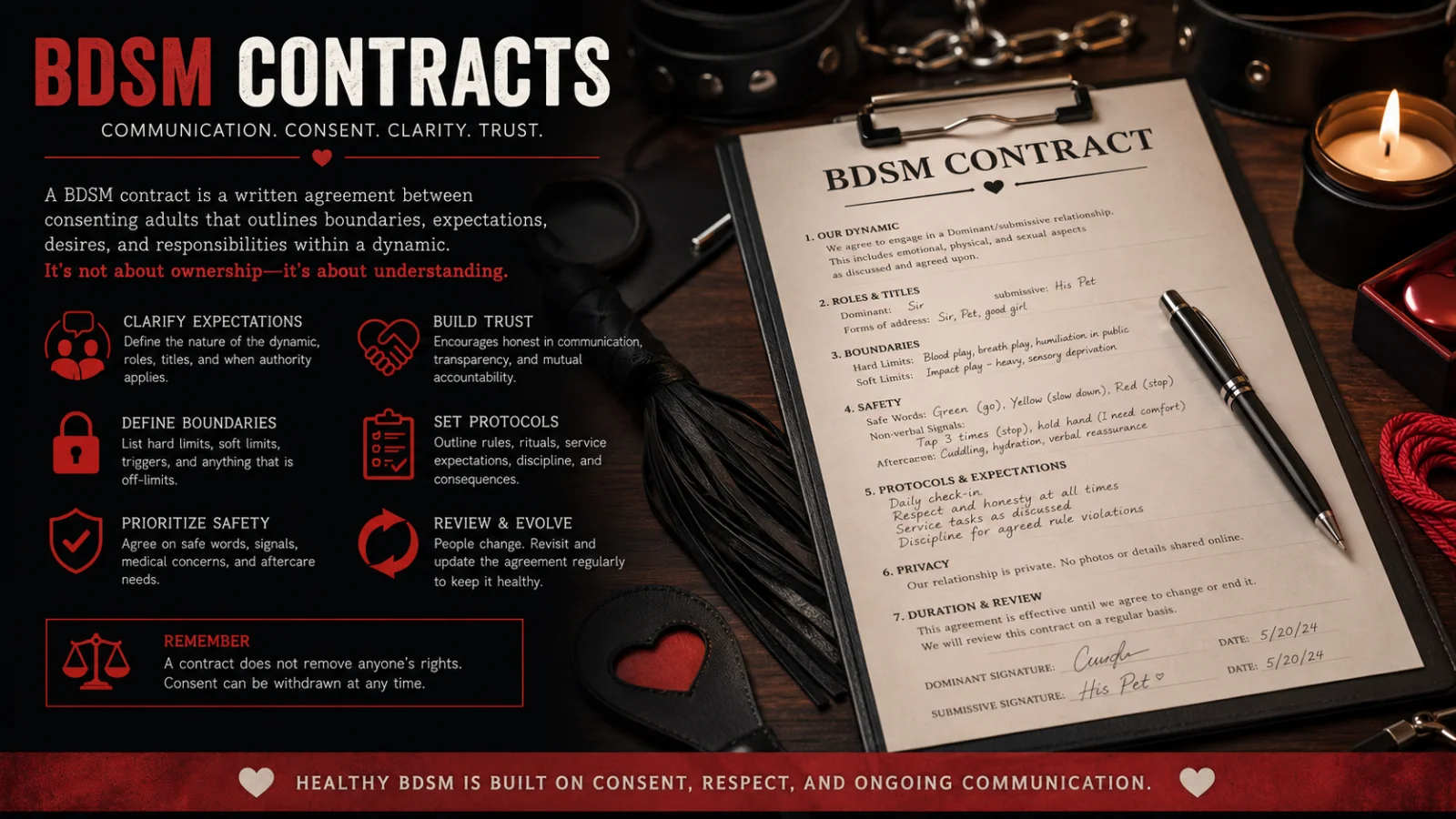

In the world of BDSM, communication is everything. While movies and media often portray BDSM as spontaneous, mysterious, or dangerous, healthy BDSM relationships are usually built on something far less dramatic but far more important: clear expectations, informed consent, and ongoing communication. One of the tools many people use to support that communication is the BDSM contract.
A BDSM contract is not about ownership in a literal legal sense. Instead, it is a negotiated agreement between consenting adults that outlines boundaries, expectations, desires, responsibilities, and consent within a BDSM dynamic.
For some, contracts are symbolic and romantic. For others, they are practical tools for structure and accountability. Whether a dynamic is casual, long-term, lifestyle-based, or purely scene-oriented, contracts can help create clarity and trust.
What Is a BDSM Contract?
A BDSM contract is a written agreement between participants in a BDSM relationship or dynamic. It can range from a simple checklist of likes and limits to a detailed multi-page agreement outlining protocols, rules, responsibilities, punishments, rituals, and emotional expectations.
Contracts may be used in:
- Dominant/submissive (D/s) relationships
- Master/slave dynamics
- Owner/property relationships
- Service dynamics
- Daddy/Mommy dynamics
- Sadomasochistic play partnerships
- Casual play arrangements
- Long-term lifestyle relationships
The purpose is not to “sign away rights,” but to create mutual understanding.
At its core, a BDSM contract is about:
- Consent
- Negotiation
- Transparency
- Accountability
- Emotional safety
- Shared expectations
Are BDSM Contracts Legally Binding?
In most places, BDSM contracts are generally not legally enforceable in the way employment or business contracts are.
A contract cannot:
- Remove someone’s legal rights
- Eliminate the need for consent
- Permit abuse
- Override criminal law
- Force someone to remain in a relationship
- Prevent someone from revoking consent
Consent can be withdrawn at any time.
Because of this, BDSM contracts are usually viewed as:
- Personal agreements
- Relationship frameworks
- Communication tools
- Symbolic commitments
Their real value is not legal enforcement — it is the conversations that happen while creating them.
Why People Use BDSM Contracts
1. Clarifying Expectations
People often enter dynamics with different assumptions.
One person may view the relationship as: 24/7 authority exchange
While the other sees it as: Bedroom-only play
A contract helps define:
- What the dynamic actually means
- When authority applies
- What each person wants
- What each person does not want
- This prevents misunderstandings later.
2. Establishing Boundaries
Healthy BDSM requires knowing limits.
Contracts often include:
- Hard limits
- Soft limits
- Medical concerns
- Emotional triggers
- Sexual boundaries
- Privacy expectations
This creates safer and more informed interactions.
3. Creating Emotional Safety
For many submissives, knowing expectations reduces anxiety.
For many Dominants, structure helps them lead responsibly.
Contracts can provide:
- Stability
- Predictability
- Reassurance
- Clarity during conflict
This becomes especially important in power exchange relationships where emotions can run deep.
4. Encouraging Honest Communication
Negotiating a contract forces people to discuss subjects they might otherwise avoid:
- Jealousy
- Monogamy
- Punishment
- Sexual health
- Living arrangements
- Public disclosure
- Relationship hierarchy
- Expectations outside scenes
These conversations are often more important than the contract itself.
Common Sections in a BDSM Contract
Every contract is different, but many include similar categories.
Identification of the Dynamic: This defines the nature of the relationship.
Examples:
- Casual play partners
- 24/7 D/s
- Master/slave dynamic
- Service-oriented relationship
- Online-only dynamic
Roles and Titles
Some contracts define titles and forms of address.
Examples:
- Sir
- Ma’am
- Master
- Mistress
- Daddy
- Mommy
- Pet
- submissive
- slave
These titles may apply:
- Always
- Only in private
- Only during scenes
Hard Limits: Hard limits are activities that are completely off-limits.
Examples may include:
- Blood play
- Humiliation
- Breath play
- Public exposure
- Financial control
- Sexual activities
- Certain physical impacts
These are non-negotiable boundaries.
Soft Limits: Soft limits are activities that may be explored cautiously under certain conditions.
These often require:
- Extra trust
- More experience
- Ongoing discussion
Safe Words and Safety Signals: Most healthy BDSM dynamics include safe words.
Common systems include the Traffic Light System.
- Green = good
- Yellow = slow down/check in
- Red = stop immediately
Nonverbal signals may also be included for:
- Gags
- Panic responses
- Nonverbal states
Rules and Protocols
Some contracts outline behavioral expectations.
Examples:
- Daily check-ins
- Manners or etiquette
- Rituals
- Service tasks
- Clothing expectations
- Sleep protocols
- Communication standards
In lifestyle dynamics, protocols may become part of daily life.
Punishments and Discipline
Some D/s relationships include agreed-upon consequences for rule violations.
Healthy discipline should:
- Be negotiated
- Be consensual
- Avoid real harm
- Never become abuse
Punishment is not an excuse for cruelty, manipulation, or uncontrolled anger.
Sexual Health Agreements
This section may cover:
- STI testing
- Barrier use
- Monogamy
- Fluid bonding
- Disclosure requirements
Honesty is critical.
Privacy and Confidentiality
Many people in BDSM value discretion.
Contracts may address:
- Photography
- Online posting
- Real-name privacy
- Community disclosure
- Social media boundaries
Duration and Review
Some contracts last:
- One scene
- A weekend
- Several months
- Indefinitely
- Many include scheduled reviews.
People change. Relationships evolve. Contracts should evolve too.
Scene Contracts vs Lifestyle Contracts
Scene Contracts: These are temporary agreements focused on a single encounter or event.
They usually cover:
- Activities
- Limits
- Safety
- Aftercare
These are common between newer partners.
Lifestyle Contracts: These govern ongoing relationships and power exchange dynamics.
They may include:
- Daily rituals
- Service expectations
- Household structure
- Emotional responsibilities
- Long-term goals
These tend to be far more detailed.
Contracts Should Never Replace Consent
One of the biggest misconceptions in BDSM is that a contract gives permanent permission.
It does not.
Consent must remain:
- Informed
- Ongoing
- Freely given
- Revocable
Even in intense power exchange relationships, consent still matters at every stage.
A submissive can say no.
A Dominant can stop a scene.
Either person can renegotiate or leave the relationship.
Healthy BDSM depends on mutual respect — not coercion.
Red Flags Around BDSM Contracts
Contracts can become unhealthy when used manipulatively.
Be cautious if someone:
- Demands a contract immediately
- Uses contracts to isolate you
- Claims ownership removes your rights
- Discourages outside support systems
- Refuses negotiation
- Punishes boundary-setting
- Says “real submissives don’t need limits”
- Treats consent as permanent
Healthy Dominants understand that trust must be earned.
Contracts as Living Documents
Many experienced practitioners view BDSM contracts as evolving agreements rather than rigid rules.
Over time:
- Interests change
- Comfort levels shift
- Relationships deepen
- Limits evolve
- Life circumstances change
- Good communication means revisiting agreements regularly.
A contract should grow with the relationship.
Final Thoughts
BDSM contracts are not about control through paperwork. They are about intentional communication, negotiated consent, and building trust through clarity.
A well-written contract can:
Prevent misunderstandings
Strengthen communication
Increase emotional safety
Help partners explore BDSM responsibly
The strongest BDSM dynamics are not built on fear or blind obedience. They are built on honesty, mutual respect, and the understanding that power exchange only works when everyone involved feels safe, heard, and valued.